We use cookies to improve functionality and personalize your content. To ensure compliance with the latest e-Privacy directive, we kindly ask for your consent to set these cookies. Learn more.

Sample Preparation Guides
General Information
Occurrence – Aluminum is the second element in Group 13. Average abundance of aluminum is 8.1% in Earth’s crust, 0.9-6.5% in soil, ~400 parts per billion (ppb) in streams, ~50 ppb in US drinking water, and less than 0.1 ppb in ground water.1
Aluminum is found in Earth’s crust in combination with oxygen and silicon, forming feldspars, clay minerals, and micas. Aluminum is not essential for plant or animal survival but can prove toxic in marine environments at levels exceeding 1.5 parts per million (ppm). In addition, a possible link between elevated aluminum levels in brain tissue and the prevalence of Alzheimer’s disease has been observed.
Chemical Properties – Aluminum has an atomic number of 13, atomic mass of 26.98, a density lower than other common metals, and one stable isotope, 27Al. Aluminum has three oxidation states: +1, +2, and +3, with +3 being the most common oxidation state in which aluminum forms compounds; similar to other elements in the boron group. Aluminum has an electron configuration of 3s2 3p1and tends to form covalent bonds.
Uses – Aluminum and associated alloys are used for heat conductivity, food preservatives, building material, containers, deodorants, and aircraft parts.
Bauxite and corundum (minerals formed by aluminum and silicon/oxygen in Earth’s crust) are used as abrasives.
Alum- a compound with the general formula X Al(SO4)2, where X is a monovalent cation such as ammonium or potassium - is used in water treatment as a flocculant, in styptic products which stop bleeding from minor injuries, as adjuvant in vaccines (to enhance immune response), flame retardant, vegetable pickling agent, and more.
Al Chemistry as Practiced & Observed at IV
Inorganic Ventures uses aluminum metal and aluminum nitrate starting materials with purity that is confirmed to be 99.99+% using ICP-MS and ICP-OES, with trace metallic impurities reported on the Certificate of Analysis for each lot produced. Both aluminum metal starting material is dissolved in a dilute 2:1 HCl and HNO3 mixture, while aluminum nitrate starting material is dissolved in dilute HNO3 alone.
Sampling and Handling
Stability - We have observed chemical stability in 2-100 ppb levels for several months in 1% HNO3 and at 1-10,000ppm levels for years in 2-5% HNO3, both of which were studied in low-density polyethylene (LDPE) containers.
Aluminum is soluble in HCl, HNO3, H2SO4, and strongly basic NaOH. It is stable with most metals and inorganic ions, though the presence of aluminum in solutions that also contain elements that require HF for stability can have a destabilizing effect as aluminum leaches HF away from these elements. Destabilization is avoided by increasing HF content in positive correlation with the concentration of aluminum.
For general information on sampling and sub-sampling see Part 3 of IV’s Trace Analysis Guide.
Contamination Risks – Aluminum is a very common contaminant that can be found in ppb or sub-ppb levels in most common labware. Contamination may occur from the use of aluminum-based tools, Teflon or any other plastic containers, platinum, and quartz dishes, and samples can commonly be cross contaminated by the analyst when testing cosmetics.
For more information about common contamination concerns, please see Chapters 8, 9, and 10 of the Inorganic Ventures Trace Analysis Guide.
The Metal, Alloys, Oxides and Organic Matrices
Metal and Alloys - Aluminum metal is best dissolved in HCl or HNO3. For more information on acid digestion of inorganic samples, please see Chapter 11 of the Inorganic Ventures Trace Analysis Guide.
Ores - α - Al2O3 can be prepared by Na2CO3 fusion in Pt0 followed by HCl dissolution; γ - Al2O3 is soluble in acids such as HCl. For more information on sample preparation by fusion, please see Chapter 13 of the Inorganic Ventures Trace Analysis Guide.
Organic Matrices – Samples in an organic matrix can be prepared for analysis by several methods including sulfuric/peroxide digestion, nitric/sulfuric/perchloric acid decomposition, or dry ash followed by dissolution in dilute HCl.2 For more information on sample preparation by ashing, please see Chapter 14 of the Inorganic Ventures Trace Analysis Guide.
Testing methods
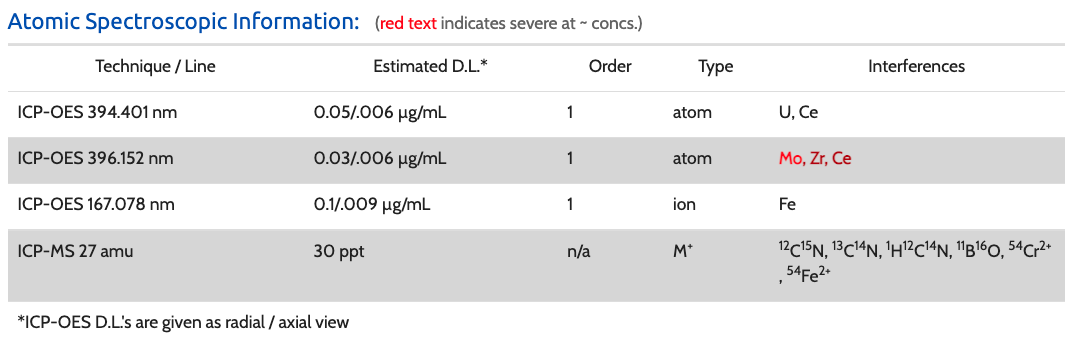
Testing Al by ICP-OES and ICP-MS can be easily performed by both instruments. Most samples will usually be free of interferences from other elements, but if an analyst is looking for low concentrations then special care should be taken to protect from contamination. Preferred ICP-OES lines and possible interferences are listed in the table below. Detailed handling information related to Al containing solutions, as well as suggestions for ICP analyses of aluminum, may be found by clicking on the Al element symbol on IV’s Interactive Periodic Table.
- Standard Methods for the Examination of Wastewater. (2012). Washington, DC: American Public Health Association.2. galena. (2019, January 06).
- Bock, R. (1979). A Handbook of Decomposition Methods in Analytical Chemistry. Weinheim/Bergstr: Verlag Chemie GmbH.