We use cookies to improve functionality and personalize your content. To ensure compliance with the latest e-Privacy directive, we kindly ask for your consent to set these cookies. Learn more.

Sample Preparation Guides
General Information
Occurrence – The overall antimony content in the earth’s crust is only about 0.2 ppm. It is most often found in nature combined with other elements as a compound, the most common one being stibnite (Sb2S3).1 The origin of its name actually comes from the Greek words “anti” and “monos” which, combined, means “not alone.”
Chemical Properties – Antimony is atomic number 51, found in Group 15, Period 5 on the Periodic Table with a molecular weight of 121.760 amu, possible oxidation states of +5, +3, and -3, and a coordination number of 6. Its two stable isotopes, 121Sb and 123Sb, have similar natural abundances of 57.2% and 42.8%, respectively.1 An interesting property of antimony is that similar to water and bismuth, it expands upon freezing/solidifying (rather than shrinking like most metals), making it ideal for uses in casting metal works from a mold.
Uses – Antimony has found uses as a pigment in paints, as a laxative/nauseant, as a flame retardant, and in alloys, such as lead, to increase the strength of the metal. It was also used historically as an eye make-up (from stibnite), and more recently in electrical components and battery materials.1
Antimony Chemistry as Practiced & Observed at IV
Inorganic Ventures uses high purity (≥ 99.998%) antimony metal as the starting material for our antimony standards, but we have antimony standards available in three different matrices: HNO3 + HF (as [SbF6]-), HNO3 + Tartaric Acid (as [Sb2(C4H2O6)2]-2), and HCl (as SbCl3 or as [Sb2(C4H2O6)2]-2 if tartrate is present).
Sampling and Handling
Stability – Antimony is stable in concentrated HCl, in dilute or concentrated HF, and in dilute or concentrated HNO3 if the antimony is fluorinated. If tartrate is used as the stabilizing ligand, it is important that the nitric acid concentration is kept dilute (<2%) to maintain stability of the tartrate. Exposure to concentrated HNO3 and other strong oxidizing agents should be avoided as this will result in oxidation of the tartrate and the loss of the tartrate as CO2. Once the tartrate has been lost, hydrolysis will occur, and Sb will precipitate. If Sb is preserved in HCl alone, the HCl concentration must be kept sufficiently high to prevent hydrolysis which will form SbOCl(s). Antimony will remain stable as the fluoride complex ([SbF6]-) in any concentration of acid, provided that other metals present in the solution are also fluorinated. Sb is not stable in HNO3 alone and requires an additional stabilizing ligand such as chloride, fluoride, tartrate, citrate, or lactate.2
Contamination Risks – Antimony contamination is a concern primarily due to human activities such as leaching from mining waste, but can also be found at higher concentrations in regions with large sulfide deposits since Sb is often found in sulfur compounds. It is also commonly found as an impurity in nickel (Ni) and molybdenum (Mo) raw materials, as well as in glass which could leach out into solutions stored in glass vessels. Antimony can also be easily volatized, so there is a risk for air contamination in areas where there is smelting of metals containing Sb deposits. Due to its toxicity, many consumer products require quantitative analytical testing and adherence to regulated concentration limits for antimony content. For example, Sb is classified as a Class 3 elemental impurity in drug products based on USP 232 and ICH Q3D. For analyses that include both Sb and Hg as analytes of interest, fluoride should be used to stabilize Sb as tartrate will reduce Hg to the metallic form (volatile).
Potential Loss During Sample Preparation – Sb is a volatile species so care must be taken when methods requiring heat, such as an ashing method, are performed. If an ashing method is required for samples containing Sb or any other volatile species, then ashing should be performed using the lowest temperature possible (400 to 550 OC maximum, preferably lower closer to ~120 OC) and the use of a platinum crucible is best as Pt will not be attacked by HF. Maintaining a low temperature during ashing will also help to prevent the formation of insoluble refractory oxides like the antimony oxides (which may then require a fusion method for digestion). When performing an acid digestion, a closed vessel method should be used to prevent loss of Sb. If performing a pyrosulfate fusion, Sb can be lost if Cl, I, or Br are present.
The Metal, Alloys, Oxides and Organic Matrices
Metal and Alloys – soluble in 1:1:1 H2O / HNO3 / HF or HCl but you may need to add hydrogen peroxide for complete dissolution (4:1 HCl / H2O2) Use extreme caution when using peroxides and add dropwise, mixing well between additions.
Oxides – may be dissolved in HCl and tartaric acid, in H2O / HNO3 / HF mixtures, or in hot KOH. Generally, antimony oxides dissolve more readily in hot KOH. If performing an acid digestion on one of the oxides, high temperature and pressure are often required.
Minerals/Ores – generally require a fusion. Recommended fusion uses a Na2CO3 flux in a Pt0 crucible, followed by dissolving the fuseate in a H2O / HNO3 / HF mixture.
Organic Matrices – Organic samples can be digested in hot, concentrated sulfuric acid, H2SO4, heated to fumes, followed by the dropwise addition of H2O2 to fully oxidize the sample. Ashing methods are generally not recommended for antimony samples due to the loss of analyte to volatilization. Closed vessel digestion methods should be used whenever possible.
Testing methods
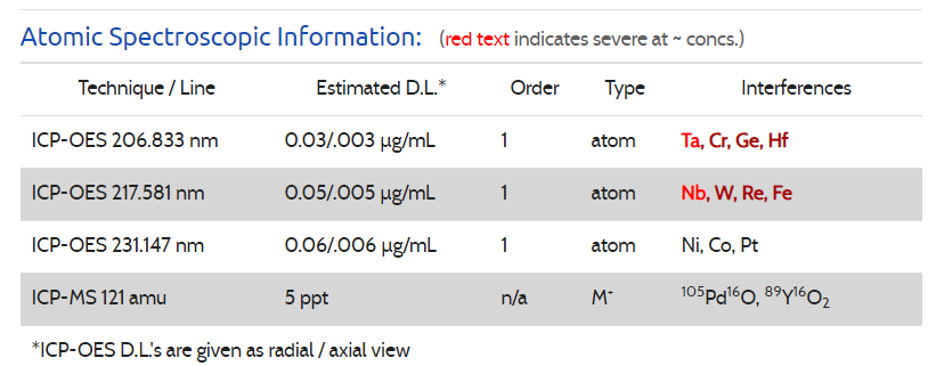
Antimony can be analyzed using ICP-OES and ICP-MS techniques. If speciation analysis is required, then a chromatographic method will also need to be employed to separate into Sb(III) and Sb(V). For low-level antimony analyses, ICP-MS is generally preferred over ICP-OES due to the high number of significant spectral interferences on the more sensitive wavelengths for antimony and much better sensitivity on ICP-MS. However, a hydride generation system can help to enhance transport efficiency, and therefore signal intensities, for Sb. On ICP-MS there is an isobaric interference on 123Sb from 123Te, so if Te is present and this interference cannot be mitigated using a correction equation, then mass 121 should be used for Sb determination. If using an internal standard on ICP-MS, then Yttrium (Y) should be avoided as there is an yttrium oxide interference on 121Sb.
Antimony can present washout issues/memory effects, especially if there is no HF present. If you’re experiencing washout issues with Sb, you can try adding ~0.2% HF to your rinse to help remove Sb. Borosilicate glass introduction systems can handle up to 0.2% HF, but boron (B) and silicon (Si) results will be unreliable until all HF is thoroughly rinse from the system. The same is true for Quartz introduction systems, with the exception that only Si results will be affected. Constant rinsing of glass or quartz with dilute HF will impact the lifespan of your sample introduction system. A better solution would be to use an HF-resistant introduction system which can handle up to 2-3% HF. However, these HF-resistant spray chambers may require refurbishment as the coating will begin to degrade over time.
References
- National Center for Biotechnology Information (2024). PubChem Element Summary for AtomicNumber 51, Antimony. Retrieved May 3, 2024 from https://pubchem.ncbi.nlm.nih.gov/element/Antimony.
- Bock, R. (1979). A Handbook of Decomposition Methods in Analytical Chemistry. Weinheim/Bergstr: Verlag Chemie GmbH.