We use cookies to improve functionality and personalize your content. To ensure compliance with the latest e-Privacy directive, we kindly ask for your consent to set these cookies. Learn more.

Sample Preparation Guides
General Information
Occurrence – Indium is the fourth Group IIIA element and has an atomic number of 49. The average abundance of indium is ~0.19 ppm in Earth’s crust, <0.01 ppb in streams, and <0.1 ppm in groundwaters.1 It typically exists as In3+ in nature and commonly occurs as a by-product of zinc and lead processing. The name was chosen by German chemists Ferdinand Reich and Hieronymous Theodor Richter due to the presence of an indigo spectral line.2
Uses – Alloys are used for corrosion resistance of bearings and in electronic devices and semiconductors. In its molten state, it clings to glass and can be used to produce seals between glass, metals, quartz, ceramic, and marble. Indium is used to measure flux of nuclear reactors.
Chemical Properties – Indium is quite soft and can be scratched with a fingernail. It exists in nature as a mixture of 113In (4.28%) and 115In (95.72%). Inhaling the metal and its compounds is toxic.
In Chemistry as Practiced & Observed at IV
Inorganic Ventures uses an indium metal starting material. Dissolution is performed in-house, and the starting material purity is found to be 99.999% using ICP-OES and ICP-MS. The trace metallic impurity data can be found in Section 5.0 of the Certificate of Analysis. Our stock offerings of MSIN-10PPM, MSIN-100PPM, CGIN1, and CGIN10, are preserved in 2% v/v HNO3.
Sampling and Handling
Indium is soluble in HCl, HNO3, and H2SO4 and is stable with most metals and inorganic ions. Neutral to basic media should be avoided. The oxalate, sulfide, carbonate, hydroxide, and phosphate are insoluble in water.
Stability – We have found that 2-100 ppb levels are stable for months in 1% HNO3. 1-10,000 ppm solutions are chemically stable for years in 2-5% HNO3. All stability studies were conducted in LDPE containers.
Contamination Risks – Gallium is not a common contaminant in labware or reagents. However, analysts should always take precautions against cross-contamination between samples containing Ga. For more information about common contamination concerns, please see Chapters 8, 9, and 10 of the Inorganic Ventures Trace Analysis Guide.
The Metal, Oxides, Ores and Organic Matrices
Metal – Indium metal is best dissolved in HCl and/or HNO3.
Oxides – Indium oxides are soluble in mineral acids. For more information on acid digestions of inorganic samples, please see Chapter 11 of the Inorganic Ventures Trace Analysis Guide.
Ores - For indium ores, we typically recommend carbonate fusion in Pt crucibles. The fuseate can then be dissolved in HCl. For more information on sample preparation by fusion, please see Chapter 13 of the Inorganic Ventures Trace Analysis Guide.
Organic Matrices - For organic matrices, we recommend digestion using peroxide and sulfuric acid or dry ash and dissolution in dilute HCl.
Testing Methods
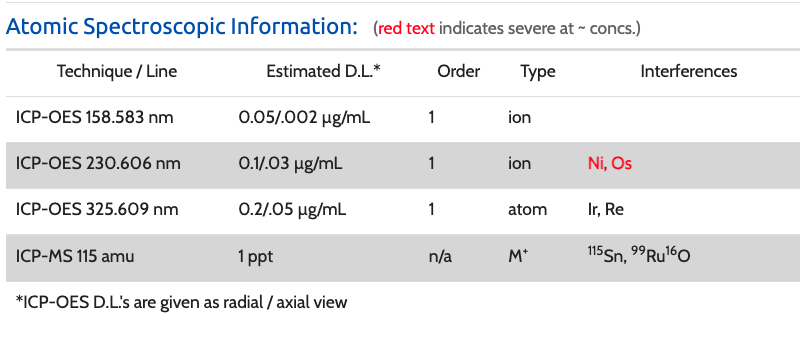
Electrothermal Atomic Absorption methods are typically recommended for In. While In is not mentioned in methods for Inductively Coupled Plasma, it can be used successfully in most cases. The user should take note of the following interferences:
1. Standard Methods for the Examination of Wastewater. (2012). Washington, DC: American Public Health Association.
2. Indium. (2021, May 23). Retrieved from Brittanica: https://www.britannica.com/science/indium