We use cookies to improve functionality and personalize your content. To ensure compliance with the latest e-Privacy directive, we kindly ask for your consent to set these cookies. Learn more.

Sample Preparation Guides
General Information
Occurrence – The overall arsenic content in the earth’s crust is about 2 ppm, however its presence varies widely by region. It is often found in combination with sulfides and metal cations and can be found in higher abundance in areas with sulfide deposits.1 It is often a byproduct of mining and smelting processes.
Chemical Properties – Arsenic is atomic number 33, found in Group 15, Period 4 on the Periodic Table with a molecular weight of 74.9216 amu and possible oxidation states of +5 and +3, and coordination number of 6. Arsenic has no cationic chemistry and will exist in solution as arsenite or arsenate. Inorganic forms of arsenic are of primary concern due to their high level of toxicity.
Uses – The primary historical use for arsenic has been in pesticides, although the use of arsenic based pesticides has been greatly reduced due to toxicity and increased environmental and health regulations. It has also been used as an additive in metal alloys and semiconductors, and as part of the active ingredients in pharmaceutical products.
Arsenic Chemistry as Practiced & Observed at IV
Inorganic Ventures uses three different starting materials for Arsenic, depending on the final product needs. Products listed as As(V) are made from arsenic pentoxide hydrate (As2O5*xH2O) starting material, while products listed as As(III) are made from arsenic trioxide(As2O3) starting material. Products which don’t specify oxidation state (concentration listed as As or Total As) are made from arsenic metal starting material. However, the arsenic in solution from arsenic metal will exist as As(V). Arsenic metal starting material is digested in concentrated HNO3 with H2O2 added in small increments to completely oxidize. The solution is heated for a full day to ensure oxidation of all As to As(V) oxidation state (arsenate). As2O5 is water soluble, but As2O3 dissolves better in an alkaline solution.
Sampling and Handling
Stability - Stable in HCl, HNO3, H3PO4, H2SO4, HF, and NH4OH matrices. Arsenic is stable in solution with most metals and inorganic anions in acidic media but can present issues when combined with Bi and Pb at high concentrations. Increasing the acid concentration can help prevent stability issues among these three elements in combined solutions. Arsenic can also form insoluble arsenates with cationic metals at neutral to basic pH, and will form arsenates when boiled with Cr. Arsenic will pull HF away from other elements in solution, so increasing the HF content when As is present may be required to stabilize other elements in the solution. When heated with nitric acid, As(III) converts to As(V).
Contamination Risks – Due to its abundance in certain mineral deposits, along with its use as a pesticide for agricultural applications, arsenic is often found as a contaminant in soils, water, and plant tissues. Certain plants are particularly efficient at absorbing As from their environment and can accumulate arsenic and other heavy metals at high levels within their tissues. Arsenic can also be volatized, so there is a risk for air contamination in areas where there is smelting of metals containing As deposits. Due to its high toxicity and risk of occurrence, many consumer products have strict regulations on limits for arsenic content and it is included in what are considered “The Big Four” heavy metals (along with cadmium, lead, and mercury). It is also classified as a Class 1 elemental impurity in drug products based on USP 232 and ICH Q3D.
The Metal, Alloys, Oxides and Organic Matrices
Metal – dissolves when heated in 1:1 H2O / HNO3. May require H2O2 or another strong oxidizing agent to fully react. Use extreme caution when using peroxides and add dropwise, mixing well between additions. For tips and safe use of perchloric acid and other acid digestions, please see Section 12 of our Trace Analysis Guide.
Oxides –exist in crystalline and amorphous forms where the amorphic form is more water-soluble. Typically dissolve in dilute acidic solutions when boiled. Some, like As2O3 for example, dissolve better in alkaline solutions.
Minerals – 1 g of powdered sample is fused in a Ni0 crucible with 10 g of a 1:1 K2CO3 / KNO3 mix. The fuseate can then be extracted with hot water.2
Organic Matrices – 0.2-0.5 g of sample are fused in a Ni0 crucible with 15 g of a 1:1 Na2CO3 / Na2O2 mix.2 The fuseate can then be extracted with water and acidified with HNO3. Ashing methods are not recommended for arsenic due to the loss of analyte to volatilization. Closed vessel digestion methods should be used whenever possible.
Testing methods
Arsenic can be analyzed using ICP-OES, ICP-MS, titrimetric methods, or ion chromatography. If specific forms or valence states of arsenic must be determined individually, a chromatographic or titrimetric method should be used as ICP-OES and ICP-MS alone will give results for total arsenic only. An iodimetric titration can be used to quantify As(III). Arsenite and arsenate can both be analyzed using an anion column for ion chromatography. Arsenite will elute first and will present better sensitivity than arsenate.
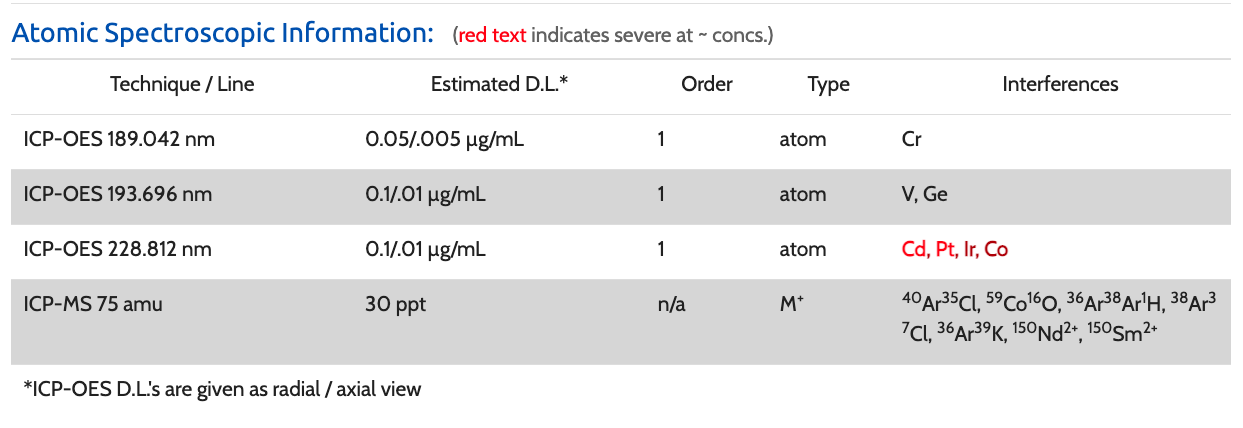
For low-level arsenic analysis, ICP-MS is generally preferred over ICP-OES due to the limited wavelength selection for arsenic and relatively low sensitivity. However, a Rowland circle (ORCA) optics system will give better sensitivity for As wavelengths and other elements that emit in the lower UV range than echelle systems. The 189 nm wavelength has the best sensitivity and fewest interferences for arsenic, although Cr and C can cause significant interferences in this region at higher concentrations. Arsenic is monoisotopic so the only mass that can be used for As on ICP-MS is 75 amu. If chloride is present at any level, a collision cell (He mode or KED mode) should be used to reduce/eliminate the ArCl interference on mass 75.
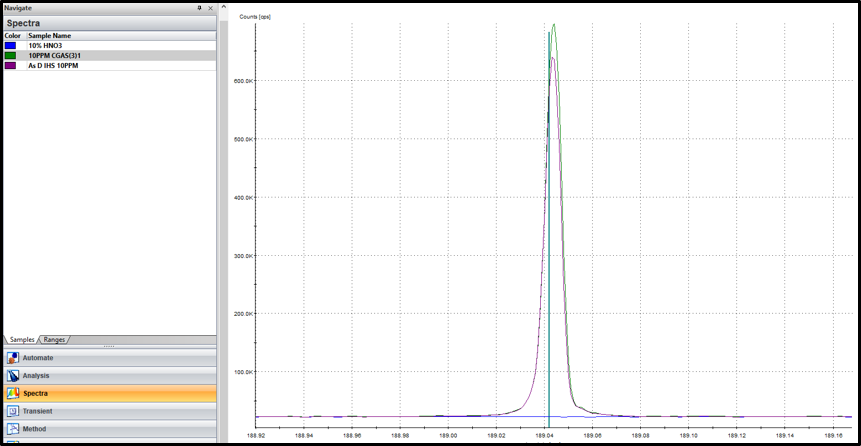
For both ICP-OES and ICP-MS analysis, it is important to have arsenic in the same oxidation state in the standards as in the samples due to differences in intensities between As(V) and As(III). Be aware that if an oxidizing agent is present in the matrix of As(III) solutions, the As has the potential to oxidize to As(V) over time. If there is a mixture of As(III) and As(V) in the solution, boiling with HNO3 will convert all As to As(V). To confirm the arsenic species contained in a sample, a titrimetric or chromatographic method is required as ICP methods alone cannot differentiate between species. There are some inconsistencies in the literature about which form gives higher intensities, but in our experience, As(III) gives higher intensities and will result in a ~4-6% high bias vs. As(V). The chart below shows an example of the overlayed spectra of a 10 ppm As(V) standard vs. a 10 ppm As(III) standard.
Green - 10 ppm As (III)
Purple - 10 ppm As(V)
See References section below for additional studies and information on the differences between As(III) and As(V) in an ICP analysis.3,4
References
1. National Research Council (US) Committee on Medical and Biological Effects of Environmental Pollutants. Arsenic: Medical and Biologic Effects of Environmental Pollutants. Washington (DC): National Academies Press (US); 1977. 3, Distribution of Arsenic in the Environment. Available from: https://www.ncbi.nlm.nih.gov/books/NBK231016/
2. Bock, R. (1979). A Handbook of Decomposition Methods in Analytical Chemistry. Weinheim/Bergstr: Verlag Chemie GmbH.
3. Effect of Valence State on ICP-OES Value Assignment of SRM 3103a Arsenic Spectrometric Solution
Lee L. Yu, Therese A. Butler, and Gregory C. Turk
Analytical Chemistry 2006 78 (5), 1651-1656
DOI: 10.1021/ac051732i
4. Differences in sensitivity between As(III) and As(V) measured by inductively coupled plasma spectrometry and the factors affecting the incoherent molecular formation (IMF) effect in the plasma
Tomohiro Narukawa, Koichi Chiba, Takayoshi Kuroiwa, and Kazumi Inagaki
Analytical Chemistry 2010 25 (5), 1682-1687
DOI: 10.1039/ C0JA00011F