We use cookies to improve functionality and personalize your content. To ensure compliance with the latest e-Privacy directive, we kindly ask for your consent to set these cookies. Learn more.

Sample Preparation Guides
General Information
Occurrence – Lead is the fifth Group IVA element, has an atomic number of eighty-two, and an atomic weight of 207.19. The average abundances of Thallium are 0.13 ppm in Earth’s crust, 2.6 ppm – 25 ppm in soil, 3 ppb in streams, and <0.1 ppm in groundwaters.1 Galena (PbS) is the main source of Pb, but it is also found in Anglesite (PbSO4) and Cerussite (PbCO3). Galena can also be mined as a source of Ag, Sb, Cu, and Zn.2 Today, half of the world’s lead is recovered by recycling.
Uses – Lead is used in batteries, ammunition, and as a protective barrier around nuclear reactors. It was once commonly used in pigments, insecticides, and as a gasoline additive, but has been largely phased out of these applications.
Lead can be present as a contaminant in water from industrial wastes or from pipework in homes and businesses. The ancient Romans used Pb for their plumbing and to make cooking tools (symptoms of lead poisoning were noted during this time). Lead is retained by the body and will accumulate over time.3
Chemical Properties – Lead commonly exists as Pb2+ in solution or complexed with hydroxide or carbonate. It is flexible and silvery-white in appearance.
Pb Chemistry as Practiced & Observed at IV
Inorganic Ventures makes Lead products from Lead nitrate. The purity is typically found to be 99.999% using ICP Assay and EDTA titrimetry. The trace metallic impurity data can be found in Section 5.0 of the Certificate of Analysis. Our stock offerings, MSPB-10PPM, MSPB-100PPM, CGPB1, and CGPB10, are preserved in 0.5% v/v HNO3.
Sampling and Handling
Stability – We have found that 2-100 ppb levels are stable for months in 1% v/v HNO3. 1-10,000 ppm solutions are chemically stable for years in 2-5% HNO3. All stability studies were performed in LDPE.
Lead is soluble in HCl, HF, and HNO3 and is stable with most metals and inorganic anions. H2SO4 should be avoided. Pb can form insoluble carbonate, borate, sulfate, sulfite, sulfide, phosphate, oxalate, chromate, tannate, iodate, and cyanide in neutral aqueous media.
Contamination Risks – Lead is a very common contaminant that can be found in ppb or sub-ppb levels in most common labware. Contamination may occur from the use of metal tools, Teflon or any other plastic containers, platinum, and quartz dishes, and samples can commonly be cross contaminated. We routinely find ppt to ppb levels of Pb in concentrated HNO3. For more information about common contamination concerns, please see Chapters 8, 9, and 10 of the Inorganic Ventures Trace Analysis Guide.
The Metal, Oxides, Ores and Organic Matrices
Metal – Metallic lead is best dissolved in a 1:1 ratio of H2O:HNO3.
Oxides – Lead oxides are typically soluble in HNO3. The exception to this is PbO2, which is soluble in HCl or HF. For more information on acid digestions of inorganic samples, please see Chapter 11 of the Inorganic Ventures Trace Analysis Guide.
Ores and Alloys – We recommend dissolution using a 1:1 ratio of H2O:HNO3.
Organic matrices - We recommend dry ashing and dissolution in dilute HCl. To avoid formation of SiO2, do not heat while dissolving. For more information on ashing of inorganic samples, please see Chapter 14 of the Inorganic Ventures Trace Analysis Guide.
Testing Methods
There are multiple methods for testing Pb. Atomic absorption is commonly used used, but it should be noted that the detection limit is much higher for flame AA as opposed to graphite furnace AA. The anodic stripping voltammetry method can produce low detection limits. Rapid screening of samples for Pb may be achieved by using the Dithizone method.
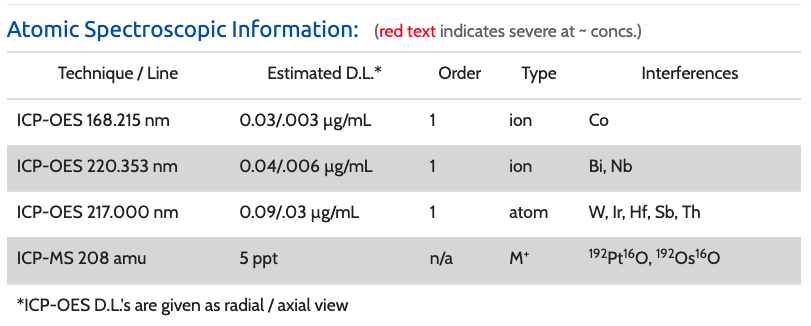
ICP-OES and ICP-MS are typically recommended, but the user should take note of the following interferences:
1. Standard Methods for the Examination of Wastewater. (2012). Washington, DC: American Public Health Association.
2. galena. (2019, January 06). Retrieved from Brittanica: https://www.britannica.com/science/galena-mineral
3. Lead. (2021, August 29). Retrieved from Brittanica: https://www.britannica.com/science/lead-chemical-element