We use cookies to improve functionality and personalize your content. To ensure compliance with the latest e-Privacy directive, we kindly ask for your consent to set these cookies. Learn more.

Sample Preparation Guides
General Information
Occurrence – Bismuth is present at ~0.00002% in the earth’s crust.1 The pure metal is quite brittle and has a very low melting point (271 ⁰C). The surface of the metal is often colorful which is due to the formation of an oxide layer. It is found in nature as the metal, oxide, sulfide, or carbonate.
Chemical Properties – Bismuth is atomic number 83, found in Group 15, Period 6 on the Periodic Table with a molecular weight of 208.98 amu and possible oxidation states of +5, +3, +1, and -3, and coordination number of 6.
Uses – Bismuth’s primary uses are in pharmaceuticals, cosmetics, fire detectors/extinguishers, alloys, and as a catalyst in plastic/rubber production.3
Bi Chemistry as Practiced & Observed at IV
Inorganic Ventures uses bismuth metal starting material with purity that is confirmed to be 99.999+% using ICP-MS and ICP-OES, with trace metallic impurities reported on the Certificate of Analysis for each lot produced. Bismuth metal starting material is digested in a ~3:1 HNO3 to DI H2O mixture, producing a final solution containing Bi in the +3 oxidation state.
Sampling and Handling
Stability - Stable in HCl, HNO3, H2SO4, and HF. Avoid basic media to prevent formation of insoluble hydroxide. Bi is stable in solution with most metals and inorganic anions in acidic media but can present issues when combined with As and Pb at high concentrations. Increasing the acid concentration can help prevent stability issues among these three elements in combined solutions. The major problem with Bi+3 is its tendency to hydrolyze at higher concentrations or in dilute acid. Nitric acid matrices should be at least 5-7% to stabilize Bi in the 100 to 10000 µg/mL concentration range. Bi will also pull HF away from other elements in solution, so increasing the HF content when Bi is present may be required to stabilize other elements in the blend.
Contamination Risks – There is a risk of contamination from cosmetic products worn by the analyst, as well as contamination from certain types of plastics or rubber components used in containers or in the production process. We recommend leaching bottles or production materials with dilute nitric acid if you experience issues with Bi contamination. For more information about common contamination concerns, please see Chapters 8, 9, and 10 of the Inorganic Ventures Trace Analysis Guide.
The Metal, Alloys, Oxides and Organic Matrices
Metal and oxides – Both metals and oxides will dissolve easily in HNO3.
Alloys – We recommend dissolution in a ratio of 4:1 in HCl:HNO3. Heating may be required to complete digestion. For more information on acid digestions of inorganic samples, please see Chapter 11 of the Inorganic Ventures Trace Analysis Guide.
Organic Matrices – We recommend dry ashing at 450-550°C followed by dissolution in dilute HNO3. You can also perform an acid digestion with concentrated hot sulfuric acid, adding hydrogen peroxide extremely carefully, dropwise, until clear.2 For more information on ashing of inorganic samples, please see Chapter 14 of the Inorganic Ventures Trace Analysis Guide.
Testing methods
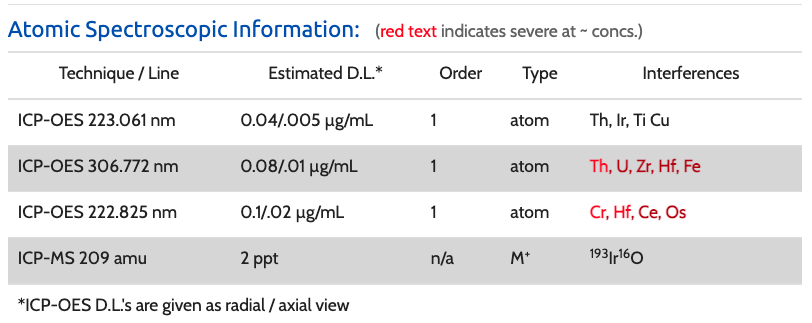
Testing for Bi can easily be done by ICP-OES and ICP-MS. However, measurements by ICP-OES may be subject to severe interferences. Please check the table below where major interferences are highlighted in red. We always recommend monitoring multiple wavelengths for your analytes when possible to identify any interferences.
Bi is often used as an internal standard for heavy metals analysis on ICP-MS as it is monoisotopic and gives very good signal response. However, Bi may be subject to oxide interference in the presence of iridium.
Bismuth can create additional trouble during analysis due to its tendency to stick to sample intro parts. This stickiness will cause longer washout times and introduce “memory effects” to your sample analysis. Peristaltic pump tubing made from PVC is the worst culprit for sticking, so it may be better to use a syringe drive system for sample introduction if this causes a large problem for sample analysis.
- Standard Methods for the Examination of Wastewater. (2012). Washington, DC: American Public Health Association.2. galena. (2019, January 06).
- Bock, R. (1979). A Handbook of Decomposition Methods in Analytical Chemistry. Weinheim/Bergstr: Verlag Chemie GmbH.
- Sanderson, R. Thomas. "bismuth". Encyclopedia Britannica, 28 May. 2021, https://www.britannica.com/science/bismuth. Accessed 4 August 2022.