
There is often confusion regarding the differences between our single-element AAS standards and single-element CG standards. This article serves as a detailed description of the main differences between the two product lines.
Uses of AAS Standards and CG Standards
AAS standards and CG standards are often used in the medicine and pharmaceutical industry and have been revolutionary in the detection of trace toxins in medicines. AAS standards and CGs have also led to the detection of elements which were previously not known to exist in certain materials, such as the presents of molybdenum and cobalt in soil. AAS and CG standards are frequently used in the detection of precious metal levels in rocks in mining operations.
Difference in Scope Between Custom Grade and AAS Standards
CG standards are manufactured and certified under our ISO 17025 and ISO 17034 Scopes, while AAS standards are manufactured and certified under ISO 9001 only.
The Accrediting body, A2LA, logos are found in Section 1 of the Certificate of Analysis.
CG Standards

AAS Standards
Certified Values and Uncertainties
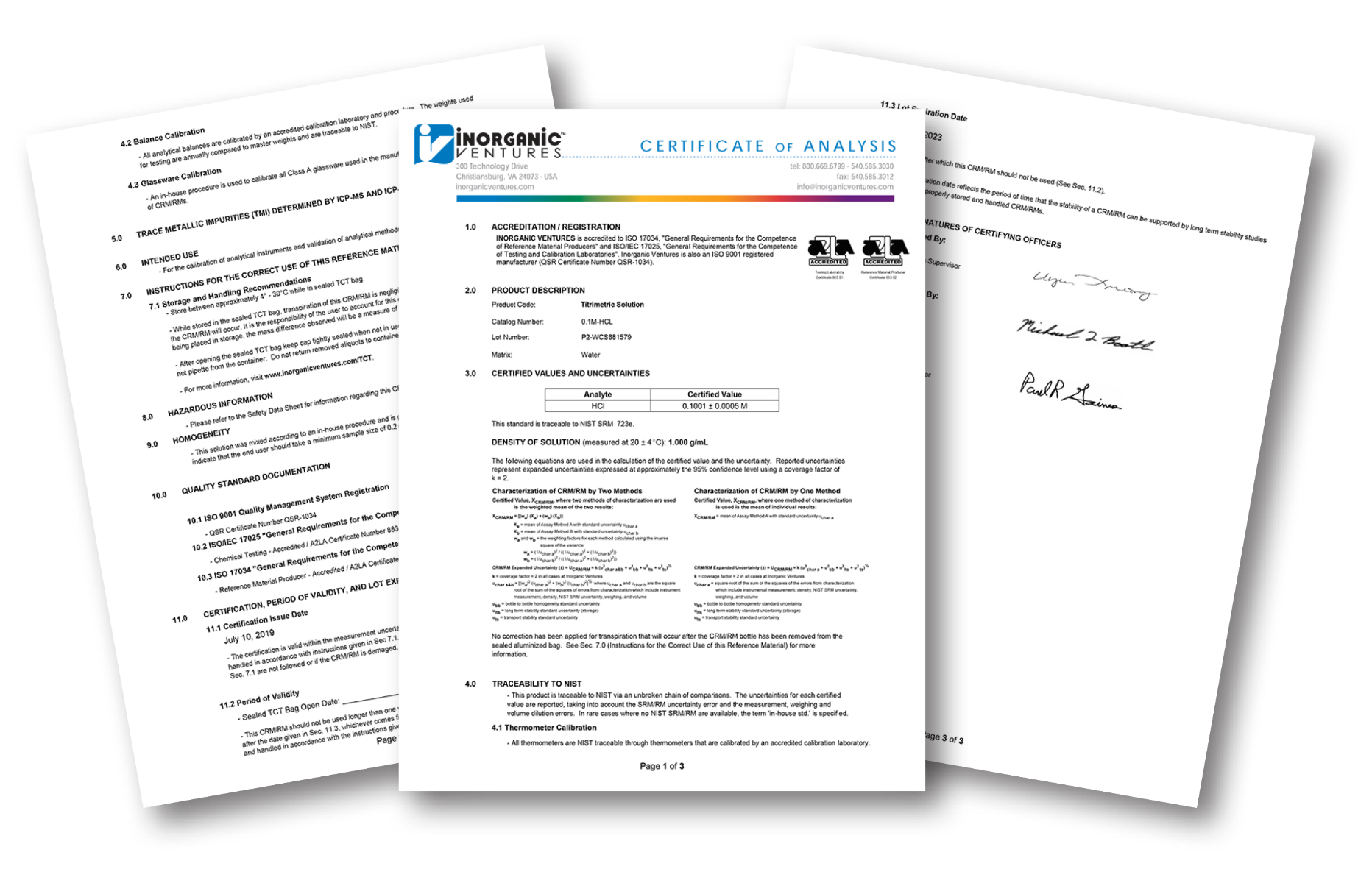
AAS standards are only verified via ICP, certified as the nominal value (1000 ppm) ONLY and are given a fixed uncertainty of ±1% or 10 ppm. CG standards are assayed using two or more independent methods and the certified value and associated uncertainty are assigned based on these test results.
The certified value for CG standards is generally within 0.5% of the nominal concentration and the uncertainty is typically lower than the fixed 1% relative uncertainty assigned to AAS standards. This information is documented in Section 3 of our CoA, along with an explanation of how the certified value and associated uncertainties were obtained.
Documentation for CG Standards vs AAS Standards
Custom Grades are comprised of more granular detail on the CoAs, such as the starting material information, including identity, lot number and purity as well as the informational TMI (trace metallic impurities) values. In many cases, the starting methods employed for Custom Grades are cleaner than those used for AAS standards, however, some AAS standards are created using the same starting materials as the Custom Grades’ counterpart.
The certificates provided in the links below can be used to illustrate the differences presented above.
If you have questions about the three major differences between our AAS and CG standards, please contact our Technical Support team.