We use cookies to improve functionality and personalize your content. To ensure compliance with the latest e-Privacy directive, we kindly ask for your consent to set these cookies. Learn more.

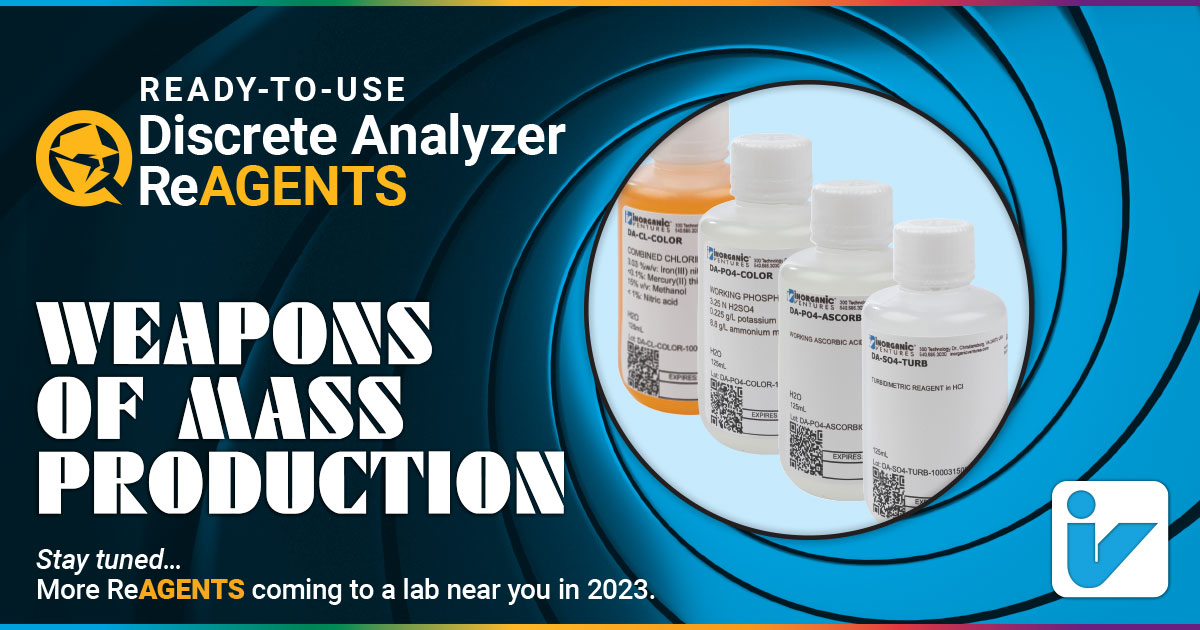
Recapture your time and increase your lab's efficiency with pre-made reagents!
We've answered some of our most commonly asked questions below.
Which instruments are the discrete analyzer reagents designed for?
Our discrete reagents can be used on the following instruments:
- Seal AQ Series
- Thermo Gallery
- Skalar BluVision
- Systea Easychem
- KPM SmartChem
- Astoria-Pacific NOXMAT
- Chinchilla Scientific Simplicity
- NeCi Superior Enzymes
Which EPA or Standard Methods are the reagents designed to follow?
Chloride (Cl-) Method
- Standard Methods 4500-Cl-E
- EPA Method 325.2
Phosphate (PO4-3) Method
- Standard Methods 4500-PO4-3E
Sulfate (SO4-2) Method
- Standard Methods 4500-SO4-2E
- EPA Method 375.4 - Sulfate, Turbidimetric
- ASTM D516-11 - Standard Test Method for Sulfate Ion in Water
- ISO 15923-1 - Water quality - Determination of selected parameters by discrete analysis systems - Part 1: Ammonium, nitrate, nitrite, chloride, orthophosphate, sulfate and silicate with photometric detection
Ammonia (NH3) Method
- ISO 15923-1
- ISO 7150/1
- EPA Method 350.1
- Standard Methods 4500-NH3 F
I operate a segmented flow analyzer. Are your discrete analyzer reagents compatible with this instrument?
The discrete analyzer reagents may work on your segmented flow analyzer. Please consult the Method Chemistry Sheets (links included above) for each product for detailed product composition. Please contact us directly for any questions.
Does shipping to or through locations with hot temperatures cause stability problems with the reagents?
Our stability studies have shown that some reagents may be sensitive to heat. All of our products undergo transport stability to ensure that temporary exposure to heat will not impact product performance. Currently we recommend the discrete analyzer reagents be stored refrigerated until our stability studies have concluded and the storage recommendations have been revised on the product CoAs.
Transpiration Control Technology (TCT) extends the shelf life of Inorganic Ventures’ standards for up to five years. Do the Discrete Analyzer Reagents have this same 5-year shelf life?
Unfortunately no. Our standards have established a 5 year chemical stability and the TCT bag helps ensure no change in concentration due to transpiration. The discrete analyzer reagents are still undergoing chemical stability testing and we are currently using the TCT bag as light protection. As of now all our discrete reagents have a 9-month shelf life and we will be updating the shelf life every 3 months for the length of the stability study.
The 500mL volume does not work for my testing requirements. Does Inorganic Ventures offer any other bottle sizes?
Whether you need a custom volume size or unique formulation, we’re happy to work with you to meet your needs. Contact us to get started!
I’m not sure if I really save time and money from making the switch from reagents made in my lab to pre-made from Inorganic Ventures. How can I be sure?
Schedule a meeting with us and we’ll walk you through your individual time and money savings! We have a savings calculator ready to go and you can take the findings back to your team.
My Standard Operating Procedure (SOP) is very complex. I’m not sure if can easily substitute new reagents into the workflow. Can you help?
No problem! We specialize in SOP Development and Implementation. Meet with one of our technical support chemists to discuss your specific SOP requirements.
I follow alternative methods on my discrete analyzer, are other methods available for purchase?
We’re launching more discrete analyzer reagents in the coming months! Next up – Ammonia. Alkalinity, Hardess, Chromium and more to follow. Let us know which ones you’re looking for!