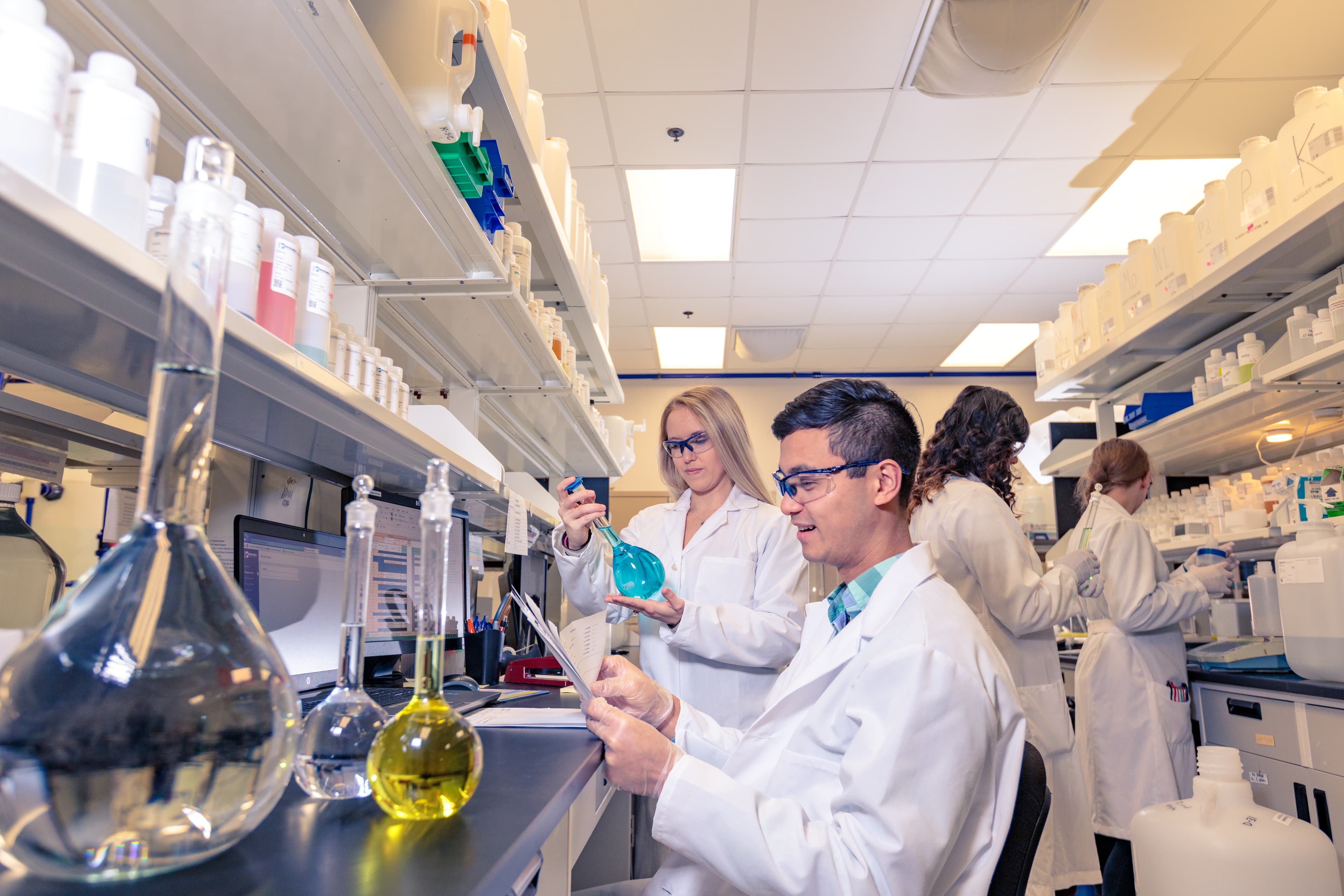
Contamination From Reagents

Trace Analysis Guide: Part 9 By Paul Gaines, Ph.D.

High Purity Water

Sample preparations using acid digestion, fusion, or ashing all typically use water as the primary reagent. Most water used in trace metal laboratories is produced by systems that use ion-exchange purification. This water is commonly referred to as "conductivity water" because its conductivity approaches the theoretical conductivity of water (0.055 microhm/cm {18.2 megohm water} at 25°C).

Under normal laboratory conditions, conductivity water never measures to be 18.2 megohm, due to the presence of CO₂ (H₂CO₃ ⇌ HCO₃⁻ + H⁺). Furthermore, if you could find water giving a conductivity of 18.2 megohm, it is not necessarily free of trace elemental contaminants, because only ionized compounds are detected by conductivity measurement.

Through carefully controlled experiments and measurements in clean room facilities, we have found that conductivity water will typically give readings closer to 16 megohm, and that it is free of trace metallic impurities down to conventional ICP-MS and axial view ICP-OES detection limits. We have also found that sub-ppb level impurities that were once thought to be coming from the water are, in actuality, from the atmosphere and the container materials (see earlier parts of this guide). We have found that the use of clean room facilities and high-temperature nitric acid-leached LDPE bottles are necessary for reliably measuring common contaminant elements in water. Therefore, do not assume that your water has significant levels of elemental contaminants if it gives conductivity readings between 16 and 17 megohm and your ICP-MS or OES is detecting trace levels of the common environmental contaminants.

Storage of High Purity Water

High purity water should be used ASAP. "Stored" high purity water may pick up impurities from the storage container. Popular storage containers are made from quartz, polyethylene (both high and low density), and fluoropolymers.

Quartz

Quartz (fused quartz or vitreous silica) typically contains 98.8% SiO₂, and impurities consisting mainly of Na₂O, Al₂O₃, Fe₂O₃, MgO, and TiO₂. Quartz has a solubility in water of 11 ppm.¹ We have measured a solubility of quartz in conductivity water of 11.2 ppm as silicic acid (equilibration time is ~4 weeks using 400 mesh quartz powder). More about quartz

HDPE and LDPE

A significant amount of HDPE is manufactured using alumina/silica-based catalysts. Long-term storage in high-density polyethylene (HDPE) can result in ppm levels of Ca, Mg, Si, Ti, Al, and ppb levels of Cr, V, and Fe. LDPE can be manufactured using an organic catalyst. Storage in HNO₃-leached LDPE is optimum. Through study, we've discovered that short-term (1-5 days) storage in both 20-liter HDPE and LDPE cubi containers that have been leached with dilute HNO₃ do not leach any elements at ICP-MS/OES detection limits.

Fluoropolymers

Fluoropolymers are not as clean as generally thought (see below figures). Studies performed in our own laboratories confirm these results. It is our recommendation that you save your money and use LDPE.

Figures 9.1 and 9.2 show total trace metals and major contributing ions for cut parts and from PFA 1 resin pellets and extruded tubing following extraction.²

Fig 9.1: Total Trace Metals & Contributing Ions for Cut Parts

Fig 9.2: Total Trace Metals & Major Contributing Ions from PFA 1 Resin Pellets and Tubing

Figure 9.3 shows the total extractable fluoride, chloride, and sulfate ions from cut fluoropolymer parts following extraction.

Fig 9.3: Fluoride, Chloride, and Sulfate Ions from Cut Parts

High Purity Acids

High purity acids have been commercially available for years, with the major impurities typically less than 1 ppb. Distilling the acid yourself may offer some improvement in purity. If you are using more than 500 mL of mineral acid per month, you may want to consider the monetary savings of distilling the acid yourself. Diagrams 9.1 and 9.2 below show typical quartz and Teflon stills.

Diagram 9.1: Pure Quartz Sub-Boiling Still

Diagram 9.2: All-Teflon Sub-Boiling Still

Tables 9.1 - 9.5 below show impurities in different Grades of the common mineral acids.

Table 9.1: Impurity Concentration in Hydrochloric Acid

ElementSub-boling distilled (ng/g)ACS Reagent-grade acid (ng/g)
Pb0.070.5
Tl0.010.1
Ba0.042
Te0.010.1
In0.01-
Cd0.020.03
Ag0.030.05
Sr0.010.05
Zn0.22
Cu0.14
Ni0.26
Fe320
Cr0.32

Table 9.2: Impurity Concentration in Nitric Acid

ElementSub-boling distilled (ng/g)ACS Reagent-grade acid (ng/g)Commercial high purity (ng/g)
Pb0.020.20.3
Tl-0.2-
Ba0.018-
Te0.010.1-
In0.01--
Cd0.010.11
Ag0.010.030.1
Sr0.012-
Zn0.0448
Cu0.04203
Ni0.05203
Fe0.32455
Cr0.056130
Ca0.23030
K0.21011
Mg0.113-
Na180-
Total Impurity2.3 ppb220 ppb220 ppb

Table 9.3: Impurity Concentration in Perchloric Acid

ElementSub-boling distilled (ng/g)ACS Reagent-grade acid (ng/g)Commercial high purity (ng/g)
Pb0.2216
Tl0.10.1-
Ba0.1>100010
Te0.050.05-
Sn0.30.03<1
Cd50.14
Ag10.10.5
Sr0.0214-
Zn0.1717
Cu0.1113
Ni0.0580.5
Fe233010
Cr91018
Ca0.27607
K0.62009
Mg0.25004
Na2600-
Total Impurity16 ppb>3400 ppb100 ppb

Table 9.4: Impurity Concentration in Sulfuric Acid

ElementSub-boling distilled (ng/g)ACS Reagent-grade acid (ng/g)
Pb0.60.5
Tl0.10.1
Ba0.30.2
Te0.10.1
Sn0.20.6
Cd0.30.2
Ag0.30.6
Sr0.30.4
Zn0.52
Cu0.52
Ni0.20.5
Fe76
Cr0.20.2
Ca2123
K49
Mg24
Na950
Total Impurity27 ppb200 ppb

Table 9.5: Impurity Concentration in Hydrofluoric Acid

ElementSub-boling distilled (ng/g)ACS Reagent-grade acid (ng/g)
Pb0.050.8
Tl0.10.2
Ba0.10.5
Te0.050.1
Sn0.0511
Cd0.032
Ag0.050.1
Sr0.10.5
Zn0.24
Cu0.23
Ni0.312
Fe0.6110
Cr520
Ca514
K128
Mg210
Na2100
Total Impurity17 ppb320 ppb

Other Reagents

The "purity" situation for salts and other reagents is typically not as favorable as it is for water and acids. Typically, the highest purity solid that can be confirmed is 99.999% (5-9's, or TMI 10 ppm). This translates to 100 ppb total impurities for a 100-fold dilution (i.e., 1 g of 5-9's pure reagent into 100 mL of solution). We recommend that you know your supplier's definition of "high purity."

CAUTION: Do NOT use solid reagent-grade materials when preparing samples for trace metals analysis, whenever possible.

If necessary, a blank should be performed to confirm the acceptability of reagent(s) or to identify problem elements/impurities. Purification of unacceptable reagents may be accomplished by mercury cathode electrolysis, extraction with dithizone or cupferron, ion exchange, or crystallization.

---

  1. Ralph K. Iler, The Chemistry of Silica, John Wiley & Sons: New York, (1979).
  2. K. J. Mikkelsen, M. J. Alberg, J. K. Prestidge, Micro, 37 (1995).

Further Reading


Additional Resources for Your Workflow

Everything you need to work smarter, from sample prep to final analysis

No items found