
Elemental and Matrix Compatibility

ICP Operations Guide: Part 1 By Paul Gaines, Ph.D.

Questions around matrix and elemental compatibility are encountered by all of us on a regular basis. This section addresses this question. Only the most popular matrices will be presented here. Consult our Interactive Periodic Table for other matrices and more information on compatibilities.

Most analysts prefer nitric acid (HNO3) matrices due to the solubility of the nitrates as well as its oxidizing ability and the relative freedom from chemical and spectral interferences as compared to acids containing Cl, S, F, or P. In addition, HNO3 is very popular in acid digestion sample preparations.

The elements that are stable/soluble and commonly diluted in aqueous/HNO3 are shaded in red below:

Nitric Acid Matrices

  1. Os should never be mixed with HNO₃ due to the formation of the very volatile OsO₄.
  2. Cl is oxidized to molecular Cl₂ which is volatile and adsorbs on plastic.
  3. Br and I are oxidized to molecular Br₂ and I₂ which adsorb onto plastic.
  4. Dilutions of Hg and Au in HNO₃ below 100 ppm should be stored in borosilicate glass due to Hg⁺² adsorption on plastic.
  5. Not soluble above concentrations of 1000 µg/mL.
  6. Trace levels of HCl or Cl⁻ will form AgCl, which will photoreduce to Ag⁰.

F denotes that the element can be diluted in HNO₃ if complexed with F⁻.

Cl denotes that the element can be diluted in HNO₃ if complexed with Cl⁻.

HF denotes that the element should have excess HF present when diluted with HNO₃.

T denotes that the tartaric acid complex can be diluted in HNO₃.

Hydrochloric Acid Matrices

The use of hydrochloric acid (HCl) is the next most popular acid matrix. HCl is volatile and it is corrosive to the instrument and it's electronics therefore, exposure should be kept to a minimum.

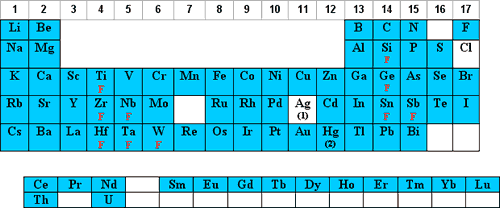
The elements that can be diluted in HCl are shaded in blue below:

  1. Concentrated (35%) HCl will keep up to 100 µg/mL of Ag⁺ in solution as the Ag(Cl)ₓ⁻⁽ˣ⁻¹⁾ complex. For more dilute solutions, the HCl can be lowered such that 10% HCl will keep up to 10 µg/mL Ag in solution.
  1. Parts-per-billion (ppb) dilutions of Hg⁺² in HCl are more stable to adsorption on the container walls than are dilutions in HNO₃.

F denotes that the element is more stable to hydrolysis if complexed with F⁻. In the case of Si and Ge the fluoride complex is generally considered a necessity.

NOTE: The Ag(Cl)ₓ⁻⁽ˣ⁻¹⁾ complex is photosensitive and will reduce to Ag⁰ when exposed to light. HNO₃ solutions of Ag⁺ are not photosensitive.

Water at pH 7

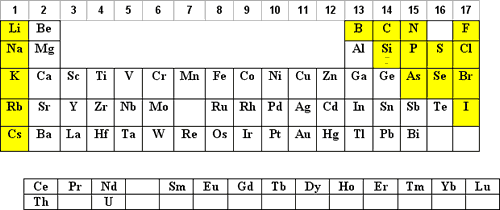
Dilutions in water at pH 7 are not as common for most elements but may be required to prevent chemical reactions of some of the compounds containing the element. Please note that solutions at pH 7 may support biological growth and therefore the long-term stability should be questioned.

Those elements that may have an advantage to being diluted in water at pH 7 are shaded in yellow below:

Hydrofluoric Acid Matrices

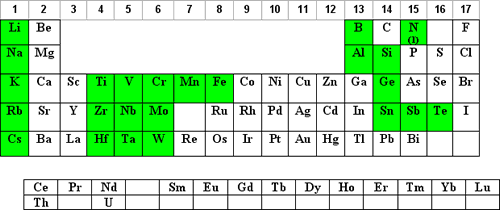
Hydrofluoric acid (HF) requires the use of HF-resistant introduction systems. These systems are more expensive than glass, have longer washout times, and give a larger measurement precision. However, there are times when the use of HF offers a major advantage over other reagents.

Those elements where an HF matrix may be optimal are shaded in green below:

HF is used for Si3N4 preparations and other nitrides.

Sulfuric Acid Matrices

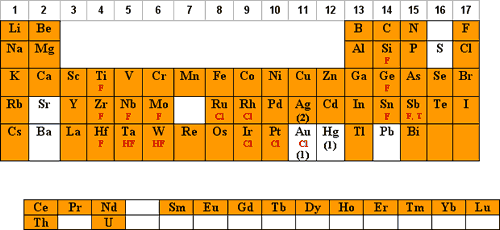
Sulfuric acid (H2SO4) is commonly used in preparations and therefore added to standards in combination with other acids.

Elements that either benefit or comfortably tolerate the presence of H2SO4 are shaded in orange below:

  1. Dilutions of Hg and Au in H2SO4 below 100 ppm should be stored in borosilicate glass due to adsorption on plastic.
  2. Trace levels of HCl or Cl- will form AgCl, which will photo reduce to Ag0.

Phosphoric Acid Matrices

Phosphoric acid (H₃PO₄) is not commonly used in preparations since it attacks glass, quartz, porcelain, and Pt containers at elevated temperatures (greater than 100 °C). However, the presence of PO₄³⁻ will not adversely affect any of the elements at low μg/mL levels and below.

If your matrix is not listed above, consult our Interactive Periodic Table or contact us for assistance.


Additional Resources for Your Workflow

Everything you need to work smarter, from sample prep to final analysis

No items found