IV Gets IC
Did you know that Inorganic Ventures specializes in Ion Chromatography? Learn more about the technique and how to overcome common challenges with our complete line of stock standards and technical support!
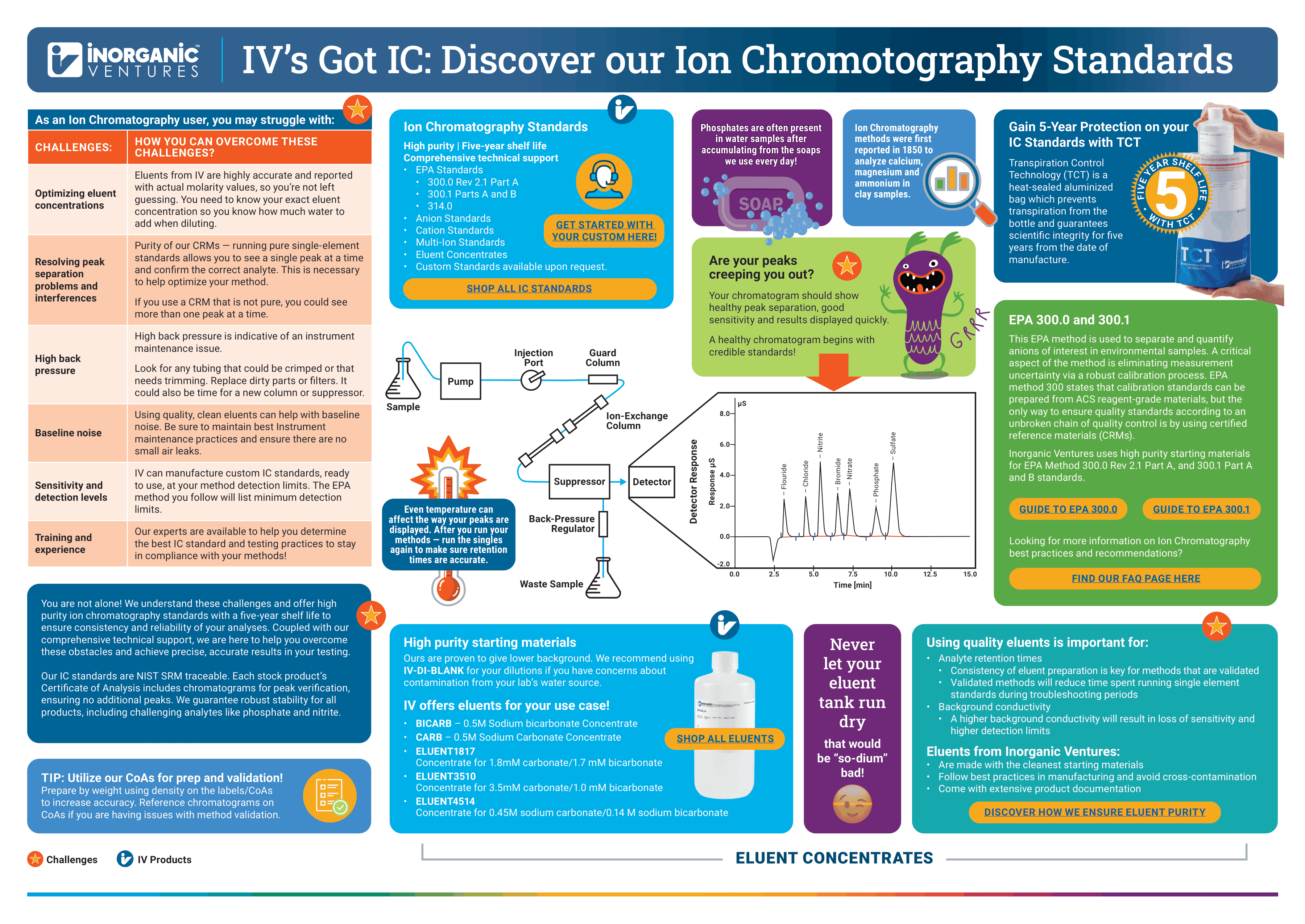
As an Ion Chromatography user, you may struggle with
You are not alone!
We understand these challenges and offer high purity ion chromatography standards with five-year shelf life to ensure consistency and reliability of your analyses. Coupled with comprehensive technical support, we are here to help you overcome these obstacles and achieve precise, accurate results in your testing.
Our IC standards come backed by:
About IC
Ion Chromatography (IC) methods were first reported in 1850 to analyze calcium, magnesium, and ammonium in clay samples!
Today, Ion Chromatography is a highly reliable and widely used technique to analyze environmental, pharmaceutical, and food/beverage samples.
IC methods are typically highly sensitive and do not require extensive sample preparation. However, a common challenge with IC is sample throughput. It can take anywhere from 10 to 20 minutes, and sometimes much longer, to run a single sample.
The Basic Steps Include:
- Your sample is injected into the column.
- Eluent pushes the sample through the instrument.
- The column separates analytes in the sample based on ionic affinity.
- Background conductivity is suppressed by chemical or electrolytic suppression.
- Conductivity is measured, and peaks appear at analyte-specific retention times.
IC is a technique used to accurately separate and quantify ions in complex matrices. Ion-exchange chromatography offers extremely high resolving power and high selectivity. The column is packed with a stationary phase designed to separate only negatively or positively charged molecules. A conductivity detector can then measure the changing conductivity of the solution as it elutes from the column. This allows analysts to detect and quantify ionic species with high levels of accuracy and precision.
The key to ensuring these results remain consistent, however, comes down to the use of IC standards. High-purity certified reference materials are essential in preserving the accuracy, precision, and reliability of measurements obtained through ion-exchange chromatography with conductivity detection.
Explore Ion Chromatography Standards from Inorganic Ventures!

EPA Standards

Anion Standards

Cation Standards

Multi-Ion Standards

Eluent Concentrates

Custom Standards
Never let your eluent run dry!
Why Clean Eluents Matter
Analyte retention time. Consistency of eluent preparation is key for validated methods, and validated methods reduce the time spent running single-element standards during troubleshooting.
Background conductivity. A higher background conductivity results in loss of sensitivity and higher detection limits.
Eluents from Inorganic Ventures
Are your peaks creeping you out?
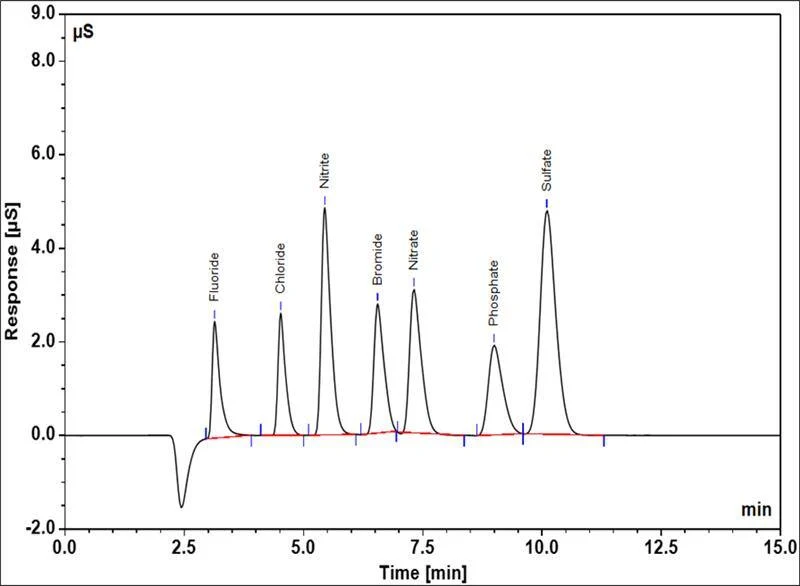
Your chromatogram should show healthy peak separation, good sensitivity and results displayed quickly! a healthy chromatogram begins with credible standards.
High purity IC standards are essential for setting up your calibration, confirming your peaks and optimizing your methods. If you are using a CRM that is not pure, you could be seeing contamination appear in your chromatogram.
Master EPA 300.0 and 300.1
These EPA methods are used to separate and quantify anions of interest in environmental samples. A critical aspect of the methods is eliminating measurement uncertainty via a robust calibration process. EPA method 300 states that calibration standards can be prepared from ACS reagent-grade materials, but the only way to ensure quality standards according to an unbroken chain of quality control is by using certified reference materials (CRMs).
Inorganic Ventures uses high purity starting materials for EPA Method 300.0 Rev 2.1 Part A, and 300.1 Part A and B standards, guaranteeing consistency and accuracy in your analysis.
