Technical Glossary
General Definitions
NMI – (National Metrology Institute)
Most countries have their own NMI which is included in an international system of labs which are tasked with ensuring universal comparability of measurement standards and capabilities.
- International System of Units (SI) traceability – this is the method by which measurement is harmonized. The NMI in each country ensures that the national standards are maintained and traceable to the SI at a stated level of confidence (measurement uncertainty). Examples include: National Institute of Standards and Technology (NIST) (United States), German National Metrology Institute (PTB), National Metrology Institute of Japan (AIST), National Research Council (NRC) (Canada).
- Have you ever wondered how the entire world agrees how much a ‘pound’ weighs? The international NMI system is how!
SRM – (Standard Reference Material)
These are registered NIST products, only NIST can provide them. Most international NMIs use NIST SRMs to achieve their traceability to the SI, making NIST SRMs uniquely crucial and valuable internationally.
- These are the standards that NIST is responsible for tracing back to the SI to ensure harmony in measurement- these are also the standards that we use for comparison testing to establish our traceability to NIST.
CRM – (Certified Reference Material)
A majority of IV’s products are certified reference materials (we do offer reagents and other uncertified products). Most of our products are certified via accredited, controlled, and audited manufacturing and testing processes and are tested against NIST SRMs.
- NIST traceability is a major selling point for our customers – the closer on the ‘unbroken chain of comparison’ a standard is to NIST, the less uncertainty the user will have in their analysis, as each step in a process adds more potential for mistakes or errors and therefore more uncertainty in the accuracy of results.
PCRM – (Primary Certified Reference Material)
This is similar to a NIST SRM in that it is a reference material that is traced back to the SI. IV created a line of trademarked products to fill a gap in SRM availability that affects our traceability for certain elements, as no NMIs provided SI traceable solutions for them – currently Os and Ir PCRMs are available in our catalog, with Ru forthcoming.
RM – (Reference Material)
This is a standard against which one could test samples, similar to CRMs, but is not certified – as such IV recommends use as analytical reagents rather than standards in comparative analysis. Traceability is not required for these products as they are not certified reference materials, but many of IV’s RM products will be 17034 applicable (as they are manufactured using our accredited procedure) and will report traceability on the product information sheet.
Accuracy vs Precision
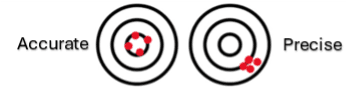
Accuracy describes how close the obtained result is to the true value. Precision describes how close obtained results are to each other. The goal is to have results that are both accurate and precise – it is best to have correct AND repeatable data.
Standard
This term indicates that the solution being described is standardized and regulated, with precise known concentrations, intended for use in quantitative analysis, unlike a “sample” which would refer to a solution with unknown composition.
Action Limits
Typically set by a regulatory agency like ISO or USP. These limits represent the minimum and maximum levels at which method performance or test results are considered ‘acceptable’. For example, many of our customers are concerned with action limits related to levels of metals like mercury or lead in food and drug products.
TMI – (Trace Metallic Impurity)
TMI analysis is a test often performed to determine the cleanliness of products like starting materials or reagents. This is a very extensive and in-depth analysis of (typically) low concentration elements that are not expected or intended in the chemical and could have the potential to disrupt certified values if used to manufacture products. For example, if we want a CRM with 1ppm lead but our acid has an impurity of 1ppm lead, the product will contain twice as much analyte as intended.
- This type of analysis is particularly time consuming and difficult due to the large concentration gap between the trace level impurity elements and the bulk or primary analyte(s) in the starting material. For example, we may analyze a 50,000 ppm aluminum solution in search of part per billion level contaminants – low level contaminants are difficult to detect, relative to the high concentration of Al.
Raw Material
This is used interchangeably with ‘starting material’; both refer to original materials used to create other products. This could, and often does, mean a solid material like metal pieces or powdered salts. This could also refer to very concentrated forms of liquids like acid. At Inorganic Ventures, we generally do not sell starting materials (as we currently cannot certify them and it is not very cost effective for us or our customers), but rather use them to create aqueous concentrates from which we manufacture our other products. Some customers will have ‘starting material requirements’ such as avoiding sulfur from sulfuric acid in solution with calcium because it may precipitate or using ammonium chloride instead of sodium chloride if they are also testing for sodium.
Measurement Uncertainty
This refers to the approximate amount that the test or certified value may differ from the true value. This is calculated by combining the level of potential error from each step of the manufacturing and testing process, as every step brings with it its own small opportunity for error. This is expressed as a plus/minus range in which the true value falls.
- Tolerance vs uncertainty
- Tolerance is the range between maximum and minimum allowed values for measurement – this is relative to what is actually possible, as human touch processes are never 100% accurate. Tolerance is how much uncertainty or discrepancy is allowed for test results.
- Certified uncertainty is the range within the tolerance limits in which we believe the true value lies. The certified uncertainty includes allowances from all errors that could happen during the manufacture, testing, packaging, transportation, and storage of a CRM product.
- Example – our 17034 scope of accreditation provides concentration ranges within which we can work to create our products. The scope also dictates Relative uncertainty, which is different from our certified uncertainty. Relative uncertainty here describes the ratio of absolute (certified) uncertainty to the measured value that is allowable under the scope.

Quantification
Giving a numerical value to a measurement; counting. In analytical chemistry, quantification often describes counting the amount of element of interest that is present in a solution.
- Alternatively, qualitative analysis would be used to identify whether an analyte is present, without determining a specific concentration. This is common when labs are testing unknown samples and have no expected analyte information.
Analyte
Substance that is being tested in an analytical procedure. For example, elements present in our products or in a customer’s sample would be called ‘analytes’ as they are the subject of the analysis being conducted. Often used interchangeably with words like ‘elements’, ‘elements of interest’, ‘compound’, or ‘solute’.
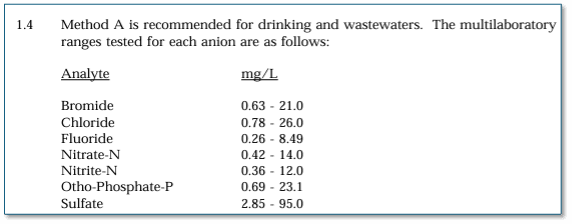
- Standardized testing methods such as EPA 300.0 will provide a list of method analytes that should be calibrated and tested for when utilizing said method:
Significant Figures
Significant Figures – digits used to report a value, where the number of digits is directly related to the precision of the value; the more digits reported, the higher the precision of calculation or measurement.
- Counted starting with the (non-zero) number farthest to the left, ending with the number farthest to the right which is either non-zero or is considered to be exact if zero.
Unit Conversion
Unit Conversion – changing the unit of measure while maintaining the quantity or value.
- Usually achieved via multiplication or division.
- Example: 1 foot is equivalent to 12 inches; therefore, the number of inches can be divided by 12 to obtain number of feet though both values communicate the same length.
- 7,894 inches is equivalent to 657.833 feet
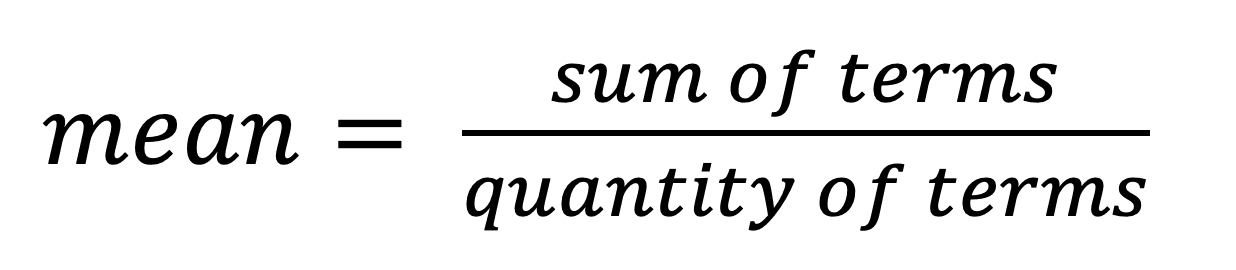
Mean
The average value of a set of numbers; represents the “center” of the data.
T-test
Statistical analysis that compares the means of two sample sets to determine statistical difference between them.
- T-tests are parametric, meaning they rely on certain assumptions:
- The data is independent
- The data is normally distributed
- The data sets have similar variance
- The type of t-test needed must be selected based on the data itself:
- Paired (data sets come from a single population)
- Two-sample (data sets come from two different populations)
- One-sample (data from a single population is compared to a standard)
- T-test tails must also be selected based on the desired outcome of analysis:
- Two tailed test should be used to determine whether two populations are different.
- One tailed test should be used to determine whether one mean is greater than the other.
Instrumentation
Working Solution
This is the diluted standard or sample that will be used for analysis on an instrument. Typically, both standards and test samples will initially be at concentrations too high for an instrument’s capabilities or calibration range and will require varying degrees of dilution in order to be usable with the method at hand.
Rinse Solution
A solution used to flush residual sample out of instrument introductory system and tubing. This is a cleaning agent used between analyses to ensure that sticky elements are not skewing data by creating memory effects or washout issues.
- Memory effects / washout – this occurs when analytes in test solutions adhere to the inside of an instrument, as future solutions travel through the instrument, sticky elements will continue to wash into samples and can give false highs or false positives, as the instrument will detect this contamination in the solution.
- Rinse solutions are not a ‘one size fits all’ product. Some acids or bases will be more effective than others at removing particular analytes. Many rinse solutions will require the use of a follow-up rinse, such as DI water, to fully rinse away analytes and rinse solution residue.
Validation
The process of ensuring an instrument or method is working as expected and performing satisfactorily for the intended use.
- This process is a critical quality control check, used to ensure that equipment and procedures are ready and able to begin work. This may include the record keeping techniques, calculations, and software used in a given process. Instruments and procedures may need to be revalidated over time or as parameters change.
- Validation is a crucial step in any accredited procedure and validation records are popular points of inquiry for auditors.
Calibration Curve
A plot of the relationship between instrument response and analyte concentration, used to determine concentration of analytes calibrated for in test samples. The calibration solutions should include all elements of interest in the test samples, ideally at concentrations ‘bracketing’ the expected sample concentrations.
- Bracketing refers to calibration of points above and below the expected test value to allow for more precise determination of sample concentration. If a sample is expected to have ~7 ppm Ca, one may calibrate at 5 ppm and 10 ppm to ‘bracket’ this expected result.
- Typical calibration curves tend to have 2 – 5 points (concentrations) for all elements of interest. This means that customers will either need to purchase 2 – 5 calibration solutions, or one solution at a higher concentration that can be diluted in their lab to create 2 – 5 solutions. In some cases, customers will buy single element solutions for each of their analytes of interest to create all of their own solutions (this option is very time consuming and can be more prone to error).
- Ideally the more calibration points built into a calibration curve the more accurate the method should be. This also increases the robustness of the method and will allow a seasoned analyst to troubleshoot results faster and more accurately.
- See section on calibrants for calibration curve example.
LOD – (Limit of detection)
Refers to the lowest signal (and therefore concentration) that can be detected by an instrument or method, to a prescribed level of certainty (frequently 95%).
Linearity
Describes the ability of an analysis to produce data points that are directly proportional to concentration (as concentration increases, the signal increases proportionally); a straight line can be used to illustrate the relationship between points (regression line).
- Indicates how accurate analysis is over the desired range of concentration.
- Regression line is a means of statistical analyzation of the data points as a set; the Y intercept indicates the possible presence of systematic error that must be corrected for. The slope of the regression line indicates the sensitivity of the analysis – the steeper the slope, the more sensitive the method is to slight concentration changes.
- The regression line must also be reported with the correlation coefficient, which indicates the degree of linearity between points. Correlation coefficient (R) is expressed as a value between 0-1, with 1 being a perfectly linear relationship.
Standard Additions
A rather manual method used for quantitative analysis, most often used for particularly difficult to test due to complex matrices which may disrupt instrument signal.
- This analysis is conducted by spiking known amounts of analyte of interest to the sample, measuring analyte response on instrument for the series of spiked samples, and plotting the results as a line so that initial analyte concentration can be extrapolated.
Isotope Dilution
A quantification method, similar to standard additions, that involves spiking a known concentration of an isotopically enriched form of the analyte of interest and measuring the subsequent isotopic ratio change.
CPS – (Counts per Second)
Signal measured by ICP-MS instruments is described with ‘counts per second’ units. This refers to the number of ions that hit the instrument’s detector each second. Counts for an analyte of interest can be compared against the number of counts in a solution with a known concentration for said analyte (calibration solution) to determine concentration of test sample.
- This signal is referred to as “Intensity” by ICP-OES users.
Signal Suppression
Signal suppression occurs when a large amount of easily ionized elements (such as sodium), typically from the solution matrix, flood the detector in an instrument and dampen the signal of the analyte of interest, making accurate detection more difficult.
- High levels of total dissolved solids (TDS) can increase signal suppression, as more electrons are available in solution to flood the detector.
- Signal suppression can be mitigated by using radial view on ICP-OES, using an internal standard, or with the use of an ionization buffer such as cesium.
Stability Program
A repetitive testing regime designed to analyze and determine the stability of a solution over time and determine usage period.
- Solutions of interest should be repeatedly tested at set intervals over a pre-determined period – typically the length of time the solution is intended to be used. Repeat testing allows analysts to ensure that certified values are remaining constant; drifting analyte concentration indicates that stability threshold has been crossed and the solution’s expiry should be set before this point.
- While IV has a stability program in house to determine lot expiration dates for products our customers may develop their own stability program to determine the shelf life of their working solutions.
CV – (Coefficient of Variability)
A ratio of a data set’s standard deviation to its average.
- Standard deviation communicates how far a data point lies from the average. Standard deviation is a measure of absolute dispersion of data points, CV is a measure of data point dispersion relative to the average.
- CV is often used to describe variation across multiple sets of data, as it can accommodate for differing averages.
- Lower CV values (usually presented as percentage values) indicate low variability (higher precision) in data.
Chromatograph
An instrument used to conduct chromatography, such as our Ion Chromatography (IC) instrument which is most often used at IV to test anion (negatively charged ion) elements like fluoride, chloride, and bromide.
Chromatogram
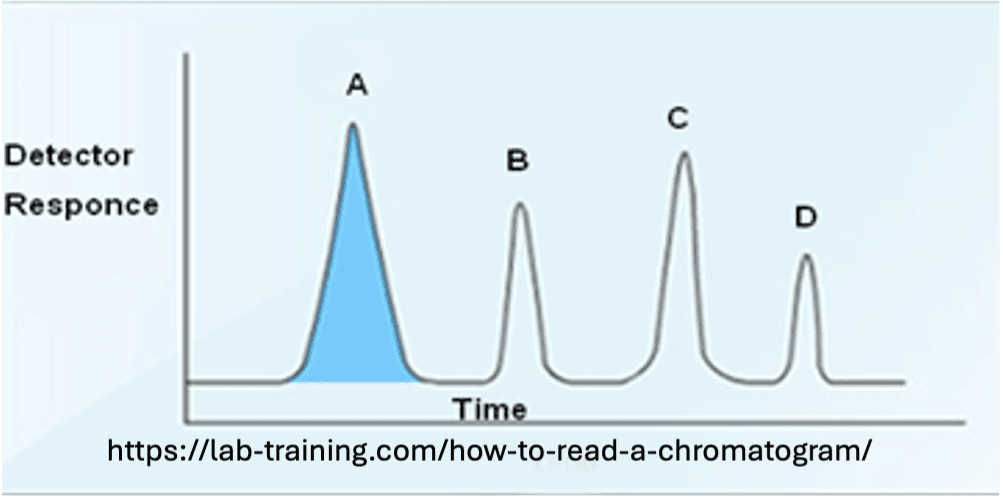
Data produced by a chromatograph.
- A graphic representation of chromatographic separation/retention time (the amount of time required for each analyte to stick to the charged column - refer to Eluent definition for explanation of analyte separation by IC column/eluents). This is plotted as a graph of detector response vs retention time – the area under each peak is proportional to the concentration of the associated analyte.
ICP-OES – (Inductively Coupled Plasma - Optical Emission Spectroscopy)
Analytical technique used to identify and quantify element concentration(s) in a solution.
- Argon gas is used to turn liquid sample into fine mist, this mist is introduced to the plasma flame which provides energy to atoms in the solution causing them to emit light at a particular wavelength. The instrument measures the amount of light emitted at a particular wavelength and compares that result to the recorded light emitted from a standard to calculate the concentration of elements associated with each wavelength measured.
ICP-MS – (Inductively Coupled Plasma – Mass Spectroscopy)
Analytical technique used to identify and quantify elements in a solution, typically of relatively low (usually parts per billion to parts per quadrillion range) concentration elements.
- Argon gas interacts with and ionizes elements in a test sample – the mass spectrometer inside the instrument separates these ions by mass to charge ratio to determine ion identity and counts number of these ions detected per second (CPS) to determine identity and concentration (by comparing to a standard) of analytes present.
Interference
An element or substance other than analytes of interest that may cause false highs or lows, false positive, or skewed results. Interference elements may be mistaken by the instrument as the analyte of interest due to similar behavior in instrument, or disrupt the sought after signals, making accurate quantification difficult or impossible.
There are several types of interference:
- Spectral – when two elements’ wavelengths or masses are very close and cause overlapping of results.
- Physical – when differences in the samples cause changes in transport efficiency or its ability to be nebulized (turned into an aerosol mist inside the instrument). This can be from something like complicated or unknown samples, or changes in lab temperature or instrument performance.
- Chemical – when standards and samples behave differently in plasma due to mismatched matrices.
Interferences can be corrected in a couple of ways:
- Interference Table – Interferences on ICP-OES can be corrected via the use of an interference table. The table is constructed by running high concentrations of very pure single element standards. All method wavelengths are monitored and whenever a response is detected for an element that should not be present in the standard it is noted. For example, running high concentration chromium will produce a signal on specific wavelengths associated with silver. We know that silver is not present in the chromium standard, so this signal is due to an interference. By collecting this data, the instrument software or analyst can use the interference table to help correct their results and provide more accurate results.
- Interference Correction Equations – Interferences on ICP-MS can be corrected via the use of equations built by collecting data on instrument response for known interferents. For example, an ^50Cr interference on ^50Ti (this is a spectral interference because both ^50Cr and ^50Ti would overlap on each other) may be corrected by monitoring the counts of ^52Cr and applying an equation to subtract the ^50Cr counts from ^50Ti. See the Inorganic Ventures website or IV Ignite for resources on correcting for interferences!
Product Information
COA – (Certificate of Analysis)
The documentation associated with each lot of product that describes necessary information about the product. CoAs include information such as starting material, matrix, density, certified concentration values, testing methods and NIST SRM traceability , along with uncertainty equations, storage and handling, and recommended use information.
- These certificates are not provided as hard copies with our shipments – CoAs and SDS are available on the IV website via our COA/SDS search function.
PIS – (Product Information Sheet)
Documentation that is provided along with products which are not certified. This document provides technical information about the product, but will not include information seen on the CoA such as traceability information, assay methods, applicable accreditations, etc.
Shelf-life
The amount of time a product can remain in storage while maintaining its scientific integrity (meaning no stability, transpiration, or storage effects are degrading the product).
- IV’s products have two ‘shelf lives’: while in the sealed TCT bag, the Lot Expiration Date is 5 years for the majority of our products. Once removed from the sealed bag, the Period of Validityis one year from the date of open (6 months for 30mL bottles), or until the Lot Expiration Date, whichever comes first. This period of validity is due to the effects of transpiration on the certified values of the product.
Lot Expiration Date
This is the date at which we have determined the chemical stability will begin to fail, or the longest period for which we have stability data with which to guarantee the integrity of our products. Most products have a 5 year lot expiration date – this is 5 years from the date of manufacture.
- Most products are chemically stable for 5+ years, so long as water loss through the walls of the bottle (transpiration), which will increase element concentration over time, is held at bay.
Think of the 5-year lot expiration date vs the one year opened bag usage period of validity like this: when a gallon of milk is purchased from the store, the milk will have a printed expiration date. This is the date at which the milk will start to spoil even when stored properly in the fridge. But, if you remove the milk from the fridge and leave it on your countertop, the milk will begin to spoil much more quickly due to the effects of the environment around it.
Element Speciation
The determination of the form of a chemical present in solution. Elements may exist in different forms, relative to the environment they are in. Many customers need to analyze a particular form of a chemical as one form may be more toxic than another in nature.
- ICP instruments will not differentiate between forms of analytes, they will see ‘total content/concentration’ – so, we may have 50 ppb of one form and 50 ppb of another, but the instrument will only see 100 ppb of the element of interest.
- IV offers very limited options for speciated standards. Our most popular are our As^+3 and As^+5 standards – we utilize specific starting material and matrix acids to achieve and maintain one form (oxidation state for these products) or another (as As^+3 can convert to As^+5 in solution, if stored in nitric acid).
SDS – (Safety Data Sheet)
This document will include information about the hazardous components of the product. Not all components will be listed here; SDS are built based on OSHA and GHS regulations and will only reflect the materials that trigger hazard codes of note.
TCT – (Transpiration Control Technology)
Our products come stored in TCT bags. These are heat sealed aluminized bags that create a watertight environment to reduce the amount of water loss from the product.
- Transpiration is the loss of water through the walls of the bottle that will increase the concentration of the analytes present over time. This process will continue until the bottle reaches equilibrium with its environment; outside of the bag, the environment is Earth’s atmosphere so transpiration will continue indefinitely, as it will never reach equilibrium.
- The TCT bag allows equilibrium to be met quickly by creating a micro-atmosphere around the product. This mitigates water loss and concentration disruption.
Hazardous vs Non-hazardous Shipping
- Generally, products containing less than 0.2% v/v acid can be shipped as non-hazardous goods. Some UN codes (four digit code used to identify hazardous goods for international shipping) may override this threshold depending on their particular associated risks.
- The Department of Transportation requires additional safety measures in packaging, labeling, stowage, and handling for any product marked ‘hazardous’, as these types of products are determined to pose a threat to human health and/or safety.
Matrix
This refers to the environment the analytes of interest are preserved in – this is commonly dilute acid (a small amount of acid combined with water) or base, depending on the analytes’ stability needs. A large portion of our products will be stored in a nitric acid matrix. Other popular matrix acids include hydrochloric, hydrofluoric, and sulfuric acid. Popular bases are ammonium hydroxide (NH_4OH), sodium hydroxide (NaOH), and triethanolamine (TEA).
- Depending on the industry and samples being analyzed the matrix may also include elements, salts, etc. that are present in high concentrations. For example, brine samples needing to be tested for heavy metals may be identified as having a matrix of concentrated NaCl.
ISO 17034
This is our ISO manufacturing accreditation. This is an international standard which dictates manufacturing processes and requirements to ensure the accuracy and reliability of certified products. This accreditation includes a company-specific scope, which dictates the types of products and concentrations that we are able to produce under the accreditation. Products that fall outside of the parameters of the scope cannot be ISO 17034 certified – we do provide products without certain accreditations, so long as they still meet the requirements of our customers’ methods.
- Scopes of accreditation are available for review on the IV website. Our 17034 scope includes the concentration ranges for specific products and the maximum relative uncertainty that would be allowed.
- Can starting materials be certified? Yes, starting material producers could potentially obtain ISO certification for their manufacturing or testing processes. However, IV is not currently able to certify or supply starting materials. Our friends at Pure have investigated the need for accredited starting materials and have found that accreditation is not a priority for customers of this particular type of product at the moment.
ISO 17025
Similar to ISO 17034, this is our testing accreditation. This accreditation provides a scope of analysis types and methods that we are accredited to utilize for the verification of our 17034 certified values (which includes calculations based on our concentrates and aliquot weights added). These methods include assay by ICP-OES, ICP-MS, Ion Chromatography, pH, Conductivity, Colorimetric, and a variety of Titrations. Some custom products cannot be tested by our 17025 accredited methods, however, if possible the certified values will come from the 17034 manufacturing process, so those products will still have certified analyte concentrations.
- Often, if a product will not fall under our 17034 scope, it will also not fall under our 17025 scope, though there are exceptions; for example, a product’s concentration may fall outside the range of our 17034 scope but may still be tested under our 17025 scope. Alternatively, more products tend to fall under 17034 but not 17025, as the 17034 scope is broader in regards to the starting materials with which we achieve the accredited outcomes, whereas 17025 lists out specific testing methods which will have much less flexibility.
- For instance, the 17034 scope lists analytes and concentration ranges for which we are accredited but does not dictate starting materials to be used. In many cases, we will have several different materials from which we could manufacture a solution of the desired analyte (such as NaCl, HCl, NH_4Cl, etc.) while maintaining the accreditation.
Sample Preparation
Gravimetric
Measurement by weight. A highly accurate method of measuring concentrates and reagents for use in preparing analytical standards and samples. Conducted on a certified and calibrated balance of appropriate measurement specificity for the desired aliquot size (at IV, a 4 decimal place balance is used for quantities under 30 grams, a 2 decimal place balance for quantities over 30 grams). Gravimetric preparation can refer to weight to weight (µg/g).
Volumetric
Measurement by volume. A method of measuring concentrates and reagents in sample preparation – less reliable and accurate than gravimetric preparation, susceptible to temperature changes, pipette/flask calibration, and chemical adhesion to consumables like pipette tips.
Deionized Water
Water that has had ions (molecules like Ca+ or F- that have a positive or negative electrical charge) removed, for use in analytical procedures where these elements may be evaluated in samples. In water, these are typically minerals and salts. If not removed, these ions can create false highs or false positives in samples being tested. This water’s analytical quality is often classed by ‘megaohms’ (MΩ) which is a measure of resistance to conduct electricity. Cleaner water will be more resistant to conduct an electrical current.
Diluent
A solution used to dilute a mixture to a desired volume, weight, or concentration. Dilute acid is the most common diluent in elemental analysis.
pH
Logarithmic expression of alkalinity or acidity where:
- pH < 7 is acidic, pH = 7 is neutral, and pH > 7 is alkaline
- pH = -log_10c where c = hydrogen ion concentration in mol/L
- pH Buffers are additives that work to prevent shifts in pH by neutralizing the acid or base added to the solution.
Microwave Digestion
The process of using microwave radiation to heat and break down solid samples to allow for analysis via methods such as ICP.
- Conducted in a suitable pressurized vessel, relative to the sample type, along with appropriate solvent to facilitate conversion to a liquid state.
Ashing
Heating a sample to remove organic carbon and volatile species to leave behind non-combustible material.
- Results in the thinning of sample along with concentration of elements present – making analysis easier.
- Often a first step in analysis of inorganic material in organic samples (such as heavy metals in plant or soil material).
Fusion
Cn also be described as melting. Fusion is the process of adding heat and/or pressure to convert the solid material from a solid to a liquid state.
- The resulting fuseate will then be treated with an appropriate solvent to dissolve into an aqueous form for analysis.
Types of Products
Reagent
Asolution or compound added to a process to create a chemical reaction or test to see if one is currently occurring or will occur. For example, adding some of our Cl Discrete Analyzer Reagent to a water sample will cause the sample to change color based on the amount of Cl present.
Titrant
A reagent of known concentration that is added to another solution during a titration to determine the concentration of the solution it is being added to. Often used with an indicator dye, which will change colors when the titration is complete, to allow for measuring the amount of titrant that is required to completely react with the second solution – this information is then used to calculate concentration.
Eluent
Solution used to extract one material from another by washing it away. Used frequently in ion chromatography (IC) – think of an eluent as the water washing away sand from gold and pebbles in a sieve. In IC, the eluent (water) washes the solution (sand) containing anions (the gold and pebbles) through the column (sieve) to separate the different analytes present for quantification. Some will be washed away faster (like the gold flakes), some will take longer (like the pebbles), and the amount of time needed to wash the components away will help us determine which is which because we already know about how long it should take each to wash out of solution.
QCS – (Quality Control Standard)
A secondary solution used to ensure that measurements and method are performing as expected.
- Second Source – standards used for quality control that come from a source independent of the ‘primary’. There are a few different definitions for ‘second source’:
- Lot number – some customers will accept a second source product that either has a different IV lot number from their primary, or was made from an alternate lot of in-house concentrates. All other aspects of the product remain constant.
- Alternate source material – some customers require that the type of starting material used differs from the material in the primary. For example, if a customer is looking for a chloride primary and secondary, they may accept a primary made from NaCl and a secondary made from HCl. Alternate starting materials help analysts ensure that their process is not affected or biased by the material of the primary, as both standards should return nearly identical chloride results.
- Alternate source provider – many customers require that their second source standard comes from a vendor that is independent from the primary. Customers commonly purchase competitor standards to use as second source checks.
- Continuing Calibration Verification (CCV) Sample – This is a standard that is tested alongside a sample (such as one of our products) that is being certified in order to validate that the procedure is working as intended. This helps monitor for changes or errors in analysis procedures that may invalidate any results obtained in testing. At IV, we call these Procedural Quality Controls (PQCs).
- Spectral Interference Check (SIC) – a method to check your elements of interest for possible interferences from other elements in your method which may disrupt results if they are not corrected for. This is best completed by preparing high concentration single element solutions for each element of interest and monitoring results to see if other elements of interest show up when looking at each element so that ratio of interference to element of interest response can be determined and used for correction.
- Interference Check Solution (ICS) – standard that contains known concentrations of interference elements (elements the instrument may mistake for one of your elements of interest), used to measure effectiveness of interference correction techniques (which are generally established based on the SIC procedure).
Internal Standard
Analytes that are different from the ones being measured but that behave similarly on an instrument, added at constant concentration to all solutions (standards and samples) used in a method, to allow for data correction if method deviation occurs. Typically used when system and random errors (such as changes in instrument behavior or environmental factors like heat or cold), which are difficult to control, are either likely or suspected.
Blank
A standard containing none of the analytes of interest, ideally made with the same acid as the other solutions in the analysis, typically used for calibration. There are a few types of blank solutions:
- Calibration Blank - used to create a ‘zero’ point on the calibration curve, as no analytes are present in solution.
- Reagent Blank – made from the same reagents used to dissolve the analyte material into solution. The readings from this blank will be subtracted from the readings of solutions containing analytes to correct for interferences or impurities present in reagents being used.
- Method Blank – made from the same reagents, stored in similar containers and conditions, and analyzed with the same procedure being used in the method in order to detect any potential issues with the process such as contamination, transpiration effects, or container compatibility (some acids may deteriorate and leach elements from container walls, for example).
Performance Check Standard
A solution with analytes of interest, internal standard elements, or other method analytes, used to evaluate performance of instrument and allow for instrument tuning when found necessary. This ensures data is reliable and instrument is compliant with regulatory standards.
Ionization Buffer
A solution added to all solutions in a method with the purpose of supplying an abundance of electrons to dampen the effect of ionization interference (this is a change in intensity that can make signals hard to measure in analysis) in high temperature environments, such as the plasma flame in an ICP-OES instrument. Just as a pH buffer keeps pH levels stable, ionization buffers keep ionization levels stable, making analysis more consistent.